
 English
 Spanish
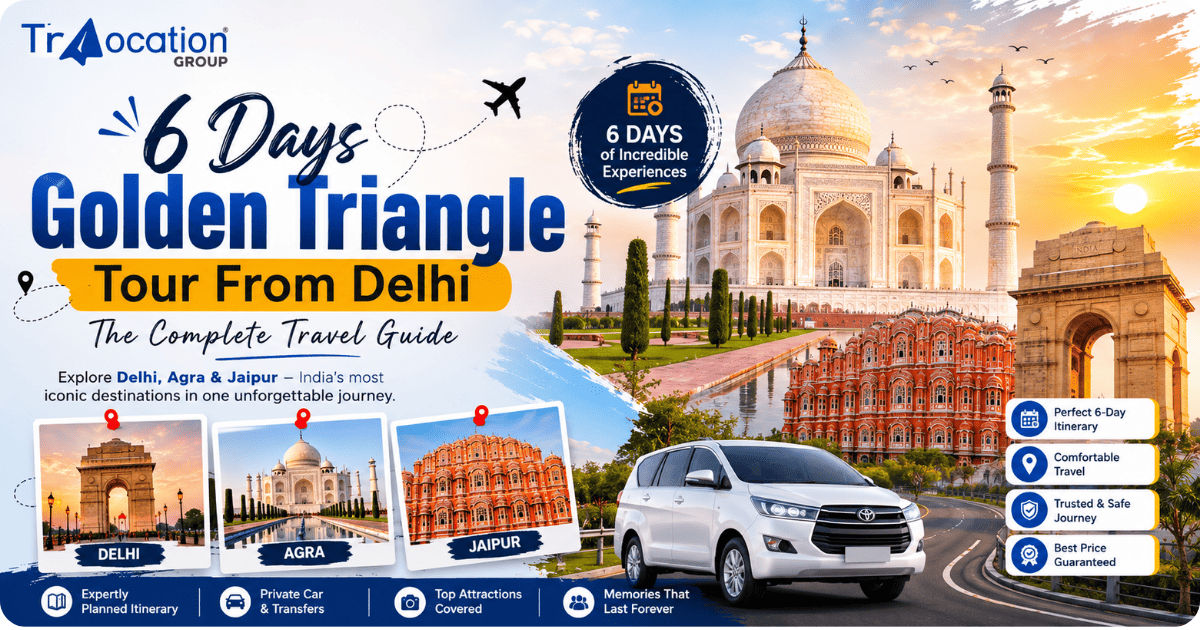
Planning a 6 Days Golden Triangle Tour From Delhi is one of the smartest decisions a first-time visitor to India can make. In just six days, this iconic circuit takes you through Delhi, Agra, and Jaipur — three cities that together tell the story of Mughal grandeur, Rajput royalty, and modern India’s beating heart. Whether you’re chasing sunrise photos of the Taj Mahal, exploring centuries-old forts, or simply want a stress-free way to see North India’s biggest highlights, a well-planned 6 Days Golden Triangle Tour From Delhi gives you the perfect balance of culture, comfort, and convenience.
This guide covers everything you need to know before booking — the day-by-day itinerary, what’s included, the best time to travel, practical tips, and answers to the most common questions travelers ask. By the end, you’ll know exactly what to expect and how to make the most of your trip.
What Is the Golden Triangle Tour?
The Golden Triangle refers to the triangular route connecting Delhi, Agra, and Jaipur — three cities located roughly 200 to 250 kilometers apart from one another in North India. When plotted on a map, their positions form a rough triangle, which is how the route earned its name.
Each city offers a completely different flavor of India:
- Delhi — the capital city, blending Mughal-era monuments with colonial architecture and a fast-paced modern skyline
- Agra — home to the Taj Mahal, one of the New Seven Wonders of the World, along with Agra Fort and Fatehpur Sikri
- Jaipur — the “Pink City” of Rajasthan, known for hilltop forts, royal palaces, and vibrant bazaars
Together, these three destinations form the most visited tourist circuit in India, and a 6-day format is considered the ideal length — long enough to explore each city properly, without rushing through the sightseeing.
Delhi, Agra, and Jaipur: A Closer Look at Each City
Understanding what makes each city unique helps you appreciate the journey beyond just a checklist of monuments.
Delhi has been a seat of power for centuries, ruled by the Delhi Sultanate, the Mughal Empire, and later the British Raj. This layered past is visible everywhere — a Mughal-era fort sits a short drive from a British colonial building, which in turn sits near a gleaming modern shopping district. For visitors, this means Delhi offers not one but several distinct experiences: the chaotic, aromatic lanes of Old Delhi; the wide, tree-lined avenues of Lutyens’ New Delhi; and the contemporary energy of neighborhoods like Connaught Place.
Agra is smaller and quieter than Delhi, but its significance in world history is enormous. As the former capital of the Mughal Empire under several emperors, it holds not just the Taj Mahal but an entire cluster of UNESCO World Heritage Sites within a short radius — a rare concentration of world-class monuments in one small city. Most travelers are surprised by how much more there is to see in Agra beyond the Taj Mahal itself.
Jaipur, in contrast, represents Rajputana rather than Mughal India — the world of maharajas, desert forts, and painted havelis. Founded in the 18th century with a deliberate, planned city layout (unusual for its time), Jaipur blends royal grandeur with a thriving crafts economy that still produces some of India’s finest textiles, gemstones, and blue pottery.
Seeing all three cities back-to-back on a single 6 Days Golden Triangle Tour From Delhi gives you a genuine sense of how India’s history unfolded across different dynasties, architectural styles, and regional cultures — something that’s hard to grasp by visiting just one city in isolation.
Quick Overview: 6 Days Golden Triangle Tour From Delhi
Before diving into the detailed itinerary, here’s a snapshot of what the trip looks like at a glance.
| Aspect | Details |
|---|---|
| Duration | 6 Days / 5 Nights |
| Cities Covered | Delhi, Agra, Jaipur |
| Total Distance | Approximately 700 km by road |
| Mode of Travel | Private air-conditioned vehicle |
| Ideal For | First-time visitors, couples, families, solo travelers, small groups |
| Best Starting Point | New Delhi (airport or railway station) |
| Best Time to Travel | October to March |
Day-Wise Itinerary for the 6 Days Golden Triangle Tour
Here’s how a typical, well-structured itinerary unfolds across the six days.
Day 1: Arrival in Delhi
Your journey begins with arrival in Delhi, where you’re received and transferred to your hotel. Depending on your arrival time, the rest of the day can be spent settling in or taking a relaxed evening stroll around a local market. This day is mostly about acclimatizing to the city before the sightseeing begins in earnest.
Day 2: Delhi City Tour — Old and New Delhi
The second day is dedicated to exploring both Old and New Delhi:
- Red Fort — the massive Mughal-era fort built by Emperor Shah Jahan
- Jama Masjid — India’s largest mosque, with sweeping views from its minarets
- Chandni Chowk — a centuries-old bazaar famous for street food and narrow lanes
- India Gate — the war memorial and one of Delhi’s most photographed landmarks
- Humayun’s Tomb — a UNESCO World Heritage Site and architectural predecessor to the Taj Mahal
- Qutub Minar — the tallest brick minaret in the world
This full day gives you a strong sense of Delhi’s layered history, from the Mughal Empire to British colonial rule and modern independence.
Day 3: Delhi to Agra — The Taj Mahal Experience
Early morning, you’ll drive from Delhi to Agra, a journey of roughly 3 to 4 hours by expressway. The highlight of this day — and arguably the entire trip — is visiting the Taj Mahal. Many travelers choose to see it at sunrise, when the white marble glows in soft golden light and the crowds are thinner.
Other stops on this day typically include:
- Agra Fort — a UNESCO-listed red sandstone fortress with a fascinating history
- Mehtab Bagh — a garden across the river offering a beautiful sunset view of the Taj Mahal
Note: The Taj Mahal remains closed on Fridays, so a well-planned itinerary always schedules the visit around this.
Day 4: Agra to Jaipur via Fatehpur Sikri
On Day 4, you travel from Agra to Jaipur, a drive of around 4 to 5 hours. En route, most itineraries include a stop at Fatehpur Sikri, the abandoned Mughal capital built by Emperor Akbar. Its Buland Darwaza — one of the tallest gateways in Asia — makes for a striking photo stop before continuing to Jaipur.
By evening, you’ll check into your Jaipur hotel and can explore a local bazaar for your first taste of Rajasthani culture.
Day 5: Jaipur Sightseeing — The Pink City
Day 5 is typically the busiest sightseeing day of the trip, covering Jaipur’s most celebrated landmarks:
- Amber Fort — a hilltop fort with stunning courtyards and the famous Sheesh Mahal (Mirror Palace)
- City Palace — still partly home to Jaipur’s royal family, with museums showcasing royal artifacts
- Jantar Mantar — an 18th-century astronomical observatory and UNESCO World Heritage Site
- Hawa Mahal — the iconic five-story “Palace of Winds” with its honeycomb facade
The afternoon can be reserved for shopping in Jaipur’s famous markets for textiles, jewelry, and handicrafts.
Day 6: Jaipur to Delhi — Departure
On the final day, you’ll drive back from Jaipur to Delhi (about 4 to 5 hours), with drop-off at the airport, railway station, or your hotel in Delhi, Noida, or Gurgaon, depending on your onward travel plans.
Day-by-Day
| Day | Route | Key Highlights | Overnight Stay |
|---|---|---|---|
| Day 1 | Arrival in Delhi | Hotel check-in, leisure evening | Delhi |
| Day 2 | Delhi Sightseeing | Red Fort, Jama Masjid, India Gate, Humayun’s Tomb, Qutub Minar | Delhi |
| Day 3 | Delhi → Agra | Taj Mahal, Agra Fort, Mehtab Bagh | Agra |
| Day 4 | Agra → Jaipur | Fatehpur Sikri, arrival in Jaipur | Jaipur |
| Day 5 | Jaipur Sightseeing | Amber Fort, City Palace, Jantar Mantar, Hawa Mahal | Jaipur |
| Day 6 | Jaipur → Delhi | Departure / drop-off | — |
What to Expect: Inclusions and Exclusions
A well-organized 6 Days Golden Triangle Tour From Delhi typically includes the essentials for smooth travel, while leaving a few optional costs for you to manage separately.
| Usually Included | Usually Not Included |
|---|---|
| Private air-conditioned vehicle for all transfers | Airfare or long-distance train tickets |
| Airport/hotel pickup and drop-off | Monument entry tickets (paid on-site) |
| Hotel accommodation as per itinerary | Personal travel insurance |
| English-speaking local guide | Tips for driver and guide |
| Toll taxes, parking, and driver allowance | Meals, unless specifically mentioned |
| 24/7 customer support | Optional activities (elephant/jeep ride, cultural shows) |
Always confirm the exact inclusions with your tour operator before booking, since packages can vary slightly.
Best Time for a 6 Days Golden Triangle Tour From Delhi
Weather plays a big role in how comfortable your sightseeing days will be, especially in Agra and Jaipur, where summers can get extremely hot.
| Season | Months | Temperature Range | What to Expect |
|---|---|---|---|
| Peak Season (Recommended) | October – March | 10°C – 28°C | Pleasant weather, clear skies, ideal for photography |
| Shoulder Season | September & April | 22°C – 38°C | Warmer but manageable, fewer crowds |
| Monsoon | July – August | 28°C – 36°C | Occasional rain, lush greenery, lower hotel rates |
| Summer (Avoid if possible) | May – June | 38°C – 46°C | Very hot, especially in Agra and Jaipur |
For most travelers, October through March offers the best combination of comfortable temperatures and clear visibility for sightseeing, especially at open-air monuments like Amber Fort and Fatehpur Sikri.
Why Choose a Private 6 Days Golden Triangle Tour From Delhi
Group tours have their place, but a private Golden Triangle tour offers distinct advantages, especially for travelers who value flexibility:
- Your own pace — no waiting for a group or rushing through a monument because the bus is leaving
- Personalized itinerary — swap the order of sightseeing, add extra stops, or skip something you’re not interested in
- Privacy and comfort — travel with only your own family or friends in a dedicated vehicle
- Better guide interaction — one-on-one time with your guide means more in-depth stories and context
- Flexible timing — start early for sunrise at the Taj Mahal, or sleep in if you prefer a relaxed morning
You May Also Read – Best Places to Visit in October: India’s Top Family-Friendly Destinations for Perfect Autumn Weather
Practical Travel Tips for Your Golden Triangle Trip
A few small preparations can make a big difference in how smoothly your trip goes:
- Dress modestly when visiting mosques, temples, and forts — shoulders and knees covered are generally appreciated
- Carry cash in small denominations for tipping and minor purchases, though most hotels and shops accept cards
- Start early for the Taj Mahal to avoid both the heat and the crowds
- Stay hydrated, particularly during the Agra and Jaipur legs of the journey
- Keep a copy of your ID and hotel bookings handy for security checks at monuments
- Check monument closing days in advance — the Taj Mahal, for instance, is closed every Friday
- Pack comfortable walking shoes since most sightseeing involves considerable walking on uneven stone surfaces
- Carry sunscreen, sunglasses, and a hat, particularly if you’re traveling in the shoulder or summer months
- Respect photography restrictions — some interior sections of palaces and forts prohibit photography or charge a separate camera fee
- Keep some buffer time in the itinerary for traffic, since road conditions between cities can vary depending on the season and time of day
- Try local cuisine at each stop — Delhi’s street food, Agra’s petha (a sweet made from ash gourd), and Jaipur’s dal baati churma are all worth experiencing along the way
Planning these small details in advance means you can focus on enjoying the monuments and culture, rather than troubleshooting logistics mid-trip.
Make Your Golden Triangle Journey Easy with Travocation
Planning every transfer, hotel, and monument visit on your own can be time-consuming, especially if it’s your first trip to India. This is where a trusted local operator makes the real difference.
Travocation specializes in curated, private North India tours, including a thoughtfully designed 6 Days Golden Triangle Tour From Delhi that takes care of every detail — private air-conditioned transport, comfortable hotel stays, and knowledgeable local guides who bring each monument’s history to life.
Here’s what makes booking with Travocation worthwhile:
- Truly private tours — you travel only with your own group, never combined with strangers
- Experienced, licensed local guides who know the region’s history and culture in depth
- Flexible, customizable itineraries — extend your trip to include Ranthambore, Udaipur, or Varanasi if you wish
- Transparent planning — clear communication on what’s included, so there are no last-minute surprises
- Round-the-clock support throughout your trip, so help is always just a call or message away
- Multilingual guide options, useful for international travelers who prefer a guide in their own language
If you’re ready to experience Delhi, Agra, and Jaipur without the stress of planning logistics yourself, explore the 6 Days Golden Triangle Tour From Delhi on Travocation and get a customized quote for your travel dates.
Frequently Asked Questions
1. Is 6 days enough for the Golden Triangle tour?
Yes, six days is considered the ideal duration for the Golden Triangle circuit. It allows a full day of sightseeing in each city — Delhi, Agra, and Jaipur — without feeling rushed, while still leaving room for markets, local food, and rest.
2. What is the best time of year to do this tour?
The most comfortable period is between October and March, when daytime temperatures are pleasant and skies are generally clear, making it easier to enjoy outdoor monuments like Amber Fort and the Taj Mahal.
3. Can the itinerary be Customized?
Most private tour operators, including Travocation, allow you to adjust the itinerary — changing hotel categories, adding extra destinations like Ranthambore or Udaipur, or rearranging the order of sightseeing to suit your preferences.
4. Do I need to book monument tickets in advance?
For popular sites like the Taj Mahal, it’s a good idea to have your tickets arranged ahead of time, especially during peak season, to avoid long queues. A private tour operator can usually manage this on your behalf.
5. Is the Golden Triangle tour suitable for families and solo travelers alike?
Yes. Because the tour uses a private vehicle and guide, it comfortably suits families with children, couples, solo travelers, and small groups of friends, with the pace adjusted to the travelers’ comfort.
Conclusion
Few travel routes in the world pack as much history, architecture, and culture into six days as the Golden Triangle. From the Mughal grandeur of Delhi’s Red Fort to the timeless beauty of the Taj Mahal at sunrise, and the royal charm of Jaipur’s palaces, this journey offers a genuine, well-rounded introduction to India. With careful planning — or better yet, with an experienced operator handling the details — your 6 Days Golden Triangle Tour From Delhi can be smooth, memorable, and completely tailored to how you like to travel.