
 English
 Spanish
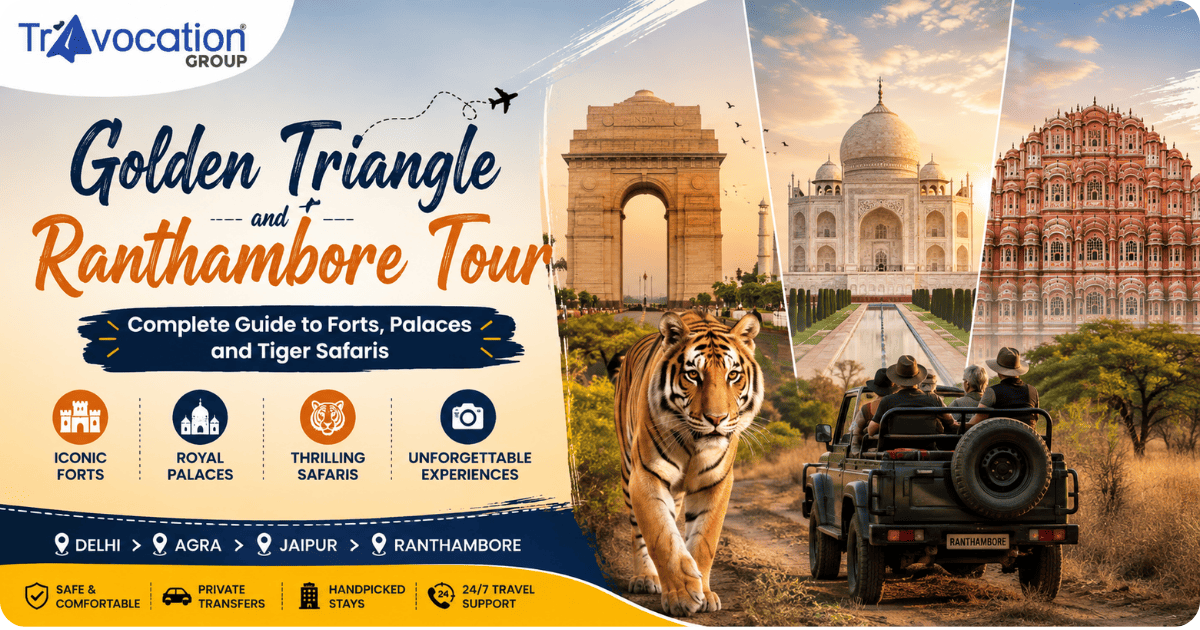
If you want to see royal India and wild India in one trip, the Golden Triangle and Ranthambore Tour is the itinerary that does exactly that. This Golden Triangle and Ranthambore Tour takes you through Delhi’s Mughal monuments, Agra’s Taj Mahal, Jaipur’s pink-hued palaces, and finally into the dry deciduous forests of Ranthambore National Park, where the Royal Bengal Tiger roams free. It’s the one trip that lets you tick off history, architecture, culture and wildlife without stitching together separate holidays.
In this guide, you’ll find a day-wise itinerary, the best time to travel, what’s included in a standard package, safari zone details, practical tips, and answers to the questions most first-time travelers ask before booking. Whether you’re planning a family holiday, a honeymoon, or a solo adventure, this guide will help you plan a smooth, well-paced trip.
What Is the Golden Triangle and Ranthambore Tour?
The “Golden Triangle” refers to the triangular travel route connecting Delhi, Agra, and Jaipur — three cities that hold some of India’s most iconic monuments, including the Taj Mahal, Red Fort, Amber Fort, and Hawa Mahal. Adding Ranthambore National Park to this circuit extends the journey into Rajasthan’s wilderness, giving travelers a genuine tiger safari experience alongside the cultural sightseeing.
This combination works so well because of geography. Ranthambore sits almost directly between Jaipur and Agra by road, so it slots naturally into the classic route without adding a long detour. That’s why most 6–8 day India itineraries pair the two.
Why This Route Works So Well for First-Time Visitors to India
- One region, four experiences — Mughal architecture, Rajputana forts, bustling bazaars, and dense forest, all within a compact geographic loop.
- Manageable travel distances — road transfers between cities range from 3 to 6 hours, so you’re never stuck in transit all day.
- A realistic wildlife chance — Ranthambore has one of the highest tiger-sighting success rates among Indian national parks, thanks to its relatively open terrain.
- Well-developed tourist infrastructure — hotels, guides, and transport options across all four destinations are mature and reliable.
- Flexible pacing — the circuit can be done in 5 days at a fast pace or extended to 8–9 days for a relaxed one.
Best Time to Visit for the Golden Triangle and Ranthambore Tour
Timing affects both your sightseeing comfort and your odds of a tiger sighting, since Ranthambore closes for part of the monsoon.
| Season | Months | Weather | Suitability |
|---|---|---|---|
| Winter | October to March | Cool, pleasant, occasional morning fog in Delhi/Agra | Best overall — comfortable sightseeing and good safari visibility |
| Summer | April to June | Hot, often above 40°C in Rajasthan | Good for tiger sightings (animals gather near waterholes) but physically demanding |
| Monsoon | July to September | Humid, park partially closed (typically 1 July–30 September) | Not recommended; Ranthambore’s core zones remain shut |
If wildlife is your priority, aim for April to June — the heat is intense, but tigers move toward water sources more predictably, improving sighting odds. If comfort matters more, November to February is the sweet spot for temples, forts, and outdoor walking.
Golden Triangle and Ranthambore Tour Itinerary (Day-by-Day)
Below is a representative 6-night, 7-day itinerary — the most commonly booked duration for this circuit. It can be shortened or extended depending on how much time you have.
| Day | Route | Key Highlights |
|---|---|---|
| Day 1 | Arrival in Delhi | Airport/hotel pickup, rest, optional evening market walk |
| Day 2 | Delhi sightseeing | Red Fort, Jama Masjid, Humayun’s Tomb, India Gate, Qutub Minar |
| Day 3 | Delhi to Agra by road | Check-in, evening at leisure, optional Mehtab Bagh sunset view of the Taj |
| Day 4 | Agra sightseeing, drive to Ranthambore | Sunrise Taj Mahal visit, Agra Fort, en route stop at Fatehpur Sikri, overnight train/road transfer to Ranthambore |
| Day 5 | Ranthambore | Morning and afternoon jungle safaris in the national park |
| Day 6 | Ranthambore to Jaipur | Drive to Jaipur, evening at leisure or local bazaar visit |
| Day 7 | Jaipur sightseeing and departure | Amber Fort, City Palace, Hawa Mahal, Jantar Mantar, drop-off |
Shorter version (5 days/4 nights): Delhi → Agra → Ranthambore → Jaipur → Delhi, compressing sightseeing into single-day visits at each stop.
Longer version (8 days/7 nights): Adds an extra night in Ranthambore for a second safari attempt, and a half-day in Pushkar or Chandigarh as an optional extension.
Places You’ll Cover on This Tour
1. Delhi
The starting and often ending point of the tour. Highlights include:
- Red Fort and Jama Masjid in Old Delhi
- Humayun’s Tomb, a precursor to the Taj Mahal’s architectural style
- India Gate and the government buildings of New Delhi
- Qutub Minar, the tallest brick minaret in the world
- Lotus Temple and Akshardham for a different architectural flavor
2. Agra
Home to the Taj Mahal, one of the Seven Wonders of the World.
- Taj Mahal, best visited at sunrise to avoid crowds and heat
- Agra Fort, a UNESCO World Heritage red sandstone fortress
- Fatehpur Sikri, an abandoned Mughal capital en route to Jaipur or Ranthambore
- Local marble inlay and leather markets
3. Ranthambore National Park
One of India’s premier tiger reserves, spread across roughly 1,334 sq. km. of forest, lakes, and ruins, including the historic Ranthambore Fort within the park boundary.
- Morning (6 AM) and afternoon (2:30 PM) safari slots, timings shift slightly by season
- Ten designated safari zones, each with different terrain and sighting patterns
- Sightings of tigers, leopards, sloth bears, marsh crocodiles, and over 300 bird species
4. Jaipur
The “Pink City” and Rajasthan’s capital.
- Amber Fort, best explored in the morning before the crowds arrive
- City Palace and its museum of royal artifacts
- Hawa Mahal, the iconic honeycomb-facade palace
- Jantar Mantar, an 18th-century astronomical observatory
- Johari Bazaar for jewelry, textiles, and block-printed fabrics
Ranthambore Safari Zones and Vehicle Options
Choosing the right safari zone and vehicle type meaningfully affects your tiger-sighting chances.
| Zone/Vehicle Type | Capacity | Notes |
|---|---|---|
| Zones 1–5 | 6-seater Gypsy or 20-seater Canter | Closer to the fort and core forest; historically higher tiger density |
| Zones 6–10 | 6-seater Gypsy or 20-seater Canter | Buffer zones, slightly lower density but less crowded |
| Gypsy (open jeep) | 6 travelers | More maneuverable, better photography angles, needs advance booking |
| Canter (open truck) | 16–20 travelers | Budget-friendly, shared with other travelers, less flexible movement |
Zones are allotted by the forest department through a computerized lottery system, so a specific zone can’t always be guaranteed — a reason to book safaris well in advance through an experienced operator.
What’s Typically Included in a Golden Triangle and Ranthambore Tour Package
A well-structured package usually bundles the following, so you don’t have to coordinate each city separately:
- Airport/hotel pickup and drop-off
- Private, air-conditioned vehicle for all road transfers
- Hotel accommodation across Delhi, Agra, Ranthambore, and Jaipur
- English-speaking local guides at each major monument
- Monument entry tickets (Taj Mahal, Agra Fort, Amber Fort, etc.)
- Jungle safari booking and permit at Ranthambore National Park
- Daily breakfast (and often dinner, depending on the plan)
Typically excluded, and worth budgeting for separately:
- Lunch, unless specified
- Camera fees at monuments
- Personal expenses, tips, and travel insurance
- Optional activities like elephant rides or cultural shows
- International or domestic flights to the starting city
Tips for a Smooth Golden Triangle and Ranthambore Tour
- Book safaris early. Ranthambore permits are capped daily and sell out fast in peak season (November–February).
- Start monument visits early in the day. Sunrise at the Taj Mahal and early-morning Amber Fort visits mean cooler weather and thinner crowds.
- Pack layers in winter. Delhi and Agra mornings can be foggy and cold (single digits °C) even though afternoons warm up.
- Wear neutral-colored clothing for safaris. Bright colors can startle wildlife and reduce sighting chances.
- Carry cash for small vendors. Cards aren’t always accepted at local markets or smaller eateries.
- Respect photography rules. Some monuments charge separate camera fees; drones are restricted or banned at most heritage sites.
- Keep a buffer day if possible. Road travel in India can be affected by traffic or weather, especially around Jaipur–Ranthambore stretches.
- Stay hydrated during summer safaris. Ranthambore’s April–June heat is intense even in open vehicles.
You May Also Read – 6 Days Golden Triangle Tour From Delhi: The Complete Travel Guide
Why Plan Your Golden Triangle and Ranthambore Tour with Travocation
Coordinating four destinations, safari permits, hotel bookings, and road logistics on your own can get complicated fast — permits get contested, good hotels fill up in peak season, and a badly timed transfer can cost you a safari slot. This is where working with a specialist operator makes a real difference.
Travocation designs the Golden Triangle and Ranthambore Tour as a fully planned circuit rather than a set of disconnected bookings. The itinerary is built around realistic travel times, pre-secured safari permits in Ranthambore, and hand-picked hotels in each city, so you spend your time sightseeing instead of managing logistics. The team also customizes the pace and duration — whether you want the compact 5-day version or a relaxed 8-day trip with an extra safari — and provides on-ground support with English-speaking guides and private vehicles throughout.
If you’re comparing options for this route, it’s worth checking Travocation’s dedicated tour page for current itinerary details, inclusions, and departure dates before finalizing your plan.
Sample 2-Day Focus: Delhi to Agra to Ranthambore
For travelers short on time, here’s how the middle stretch of the trip typically flows, since it’s the busiest transition period of the tour.
Day A — Agra
- Sunrise visit to the Taj Mahal (gates open around 6 AM)
- Breakfast at the hotel
- Agra Fort visit mid-morning
- Optional stop at a local handicraft workshop
- Evening drive or overnight train toward Ranthambore
Day B — Ranthambore
- Early check-in and rest before the first safari
- Afternoon jungle safari (2:30 PM slot)
- Evening at the resort, often with a bonfire or cultural program
- Early night ahead of the next morning’s safari
This two-day stretch is the most logistically tight part of the tour, which is why pre-booked transfers and safari permits matter most here.
Frequently Asked Questions
1. How many days do I need for the Golden Triangle and Ranthambore Tour?
Most travelers take 6 to 7 days for a comfortable pace. It’s possible to compress the trip into 5 days, but that leaves less time at each stop, especially in Ranthambore, where a second safari significantly improves your chances of a tiger sighting.
2. Is Ranthambore National Park open all year?
No. The park is generally closed from around July 1 to September 30 for the monsoon breeding season. The best visiting window is October to June, with October–March being the most comfortable weather-wise.
3. What are the chances of spotting a tiger in Ranthambore?
Sighting isn’t guaranteed since these are wild animals in a natural habitat, but Ranthambore has one of India’s higher success rates among tiger reserves. Booking two safaris instead of one, and choosing zones with historically strong sighting records, improves your odds meaningfully.
4. Can this tour be customized for families or elderly travelers?
Yes. The pace, hotel category, and vehicle type can all be adjusted. Families often add an extra night in Jaipur or Agra to slow down the itinerary, while safaris can be booked in more comfortable Gypsy vehicles rather than shared canters for elderly travelers.
5. What is the best time of year to book this tour?
October to March offers the most pleasant weather for sightseeing and safaris alike. If a tiger sighting is your main goal and you don’t mind heat, April to June often produces stronger results as animals gather near water sources.
Conclusion
Few travel routes in the world let you move from a 17th-century Mughal mausoleum to a live tiger sighting in the space of two days — the Golden Triangle and Ranthambore Tour is one of them. With the right timing, a sensible itinerary, and safari permits locked in ahead of time, it delivers both the cultural depth and the wildlife thrill that draw travelers to India in the first place. If you’re ready to plan this route without juggling four separate bookings, Travocation’s Golden Triangle and Ranthambore Tour is built to handle exactly that — itinerary, permits, hotels, and transfers, planned as one connected trip.