
 English
 Spanish
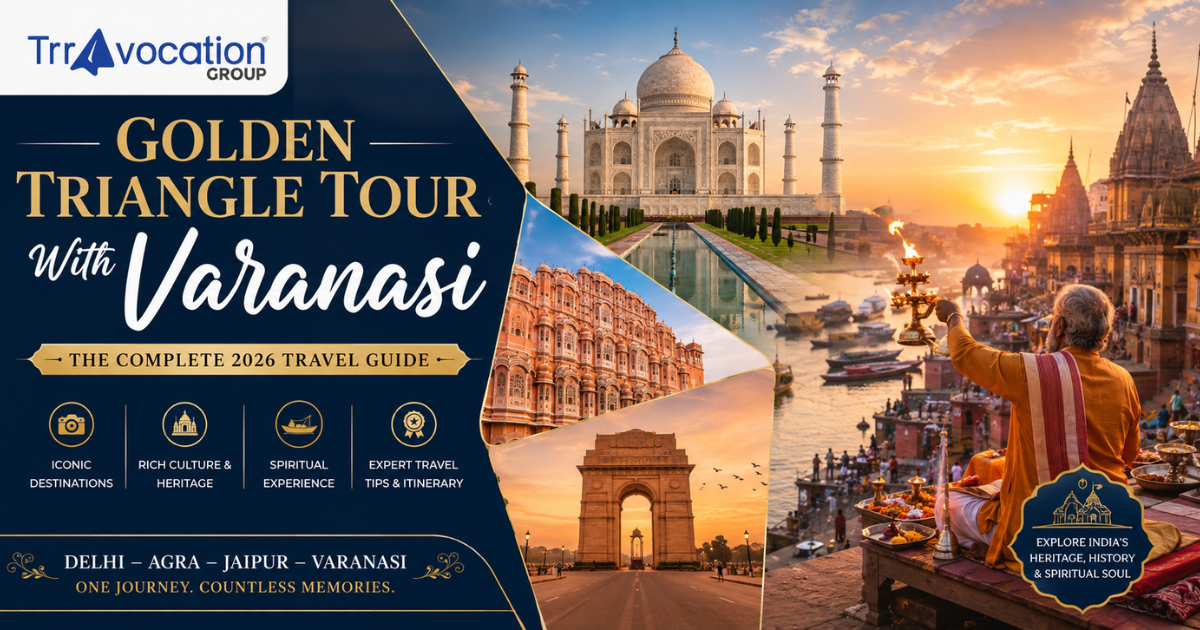
A Golden Triangle Tour With Varanasi is the one itinerary that lets you experience India’s imperial history and its living spirituality on a single trip. This Golden Triangle Tour With Varanasi combines Delhi’s monuments, Agra’s Taj Mahal, Jaipur’s pink-hued forts, and Varanasi’s sacred Ganga ghats into one seamless, private-car journey. Instead of picking between heritage and pilgrimage, you get both — in roughly eight days, with comfortable hotels, guided sightseeing, and zero logistics to worry about. Below is a research-backed, day-by-day guide to help you plan it right.
What Is the Golden Triangle Tour With Varanasi
The classic “Golden Triangle” refers to Delhi, Agra, and Jaipur — three cities that form a rough triangle on the map of North India and hold three of the country’s most visited monuments: the Red Fort, the Taj Mahal, and Amber Fort. Adding Varanasi extends this circuit eastward to the banks of the Ganges, India’s oldest continuously inhabited city and its spiritual capital.
Where the Golden Triangle shows you Mughal architecture and Rajput grandeur, Varanasi adds something the original circuit doesn’t have: living ritual. Watching the Ganga Aarti at dusk, taking a rowboat past the ghats at sunrise, and walking the narrow lanes near Kashi Vishwanath Temple gives the trip an emotional dimension that pure monument-hopping can’t.
Why Travelers Choose This Circuit
A well-designed Golden Triangle Tour With Varanasi appeals to first-time visitors and repeat travelers alike because it front-loads India’s most photographed sights while still leaving room for a genuinely different cultural experience. Here’s what makes the combination work so well:
- Efficient routing – Delhi, Agra, and Jaipur are 3–5 hours apart by road, and Varanasi connects easily by a short domestic flight
- Balanced pacing – heritage sightseeing in the first four days, spiritual immersion in the last two to three
- UNESCO density – the Taj Mahal, Agra Fort, Qutub Minar, Humayun’s Tomb, and Fatehpur Sikri all sit inside this loop
- A signature sunrise moment twice – the Taj Mahal at dawn in Agra, and the Ganges at dawn in Varanasi
- Manageable trip length – most versions run 7 to 9 days, which fits comfortably inside a two-week vacation window
A Quick Snapshot of Each City
Before diving into the itinerary, it helps to know what role each city plays in the trip.
Delhi is India’s capital and the trip’s entry point, mixing Mughal-era Old Delhi with the colonial-era boulevards of New Delhi. It’s where jet lag meets your first taste of the country’s history.
Agra exists almost entirely because of one building. The Taj Mahal draws the crowds, but Agra Fort and the ghost city of Fatehpur Sikri round out a fuller picture of Mughal power.
Jaipur, the Pink City, trades Mughal architecture for Rajput forts and palaces — Amber Fort and the City Palace are the highlights, with Hawa Mahal as the postcard shot.
Varanasi is different in kind, not just distance. It’s less about a single monument and more about an atmosphere — chanting, fire, boats, and the Ganges itself, all wrapped into daily ritual rather than a fixed sightseeing stop.
Golden Triangle Tour With Varanasi: Day-by-Day Itinerary
Most operators build this as an 8-day, 7-night private-car itinerary. The table below breaks down what a well-paced version looks like, city by city.
| Day | City | Key Activities |
|---|---|---|
| 1 | Delhi | Airport pickup, hotel check-in, evening at leisure or Connaught Place stroll |
| 2 | Delhi | Red Fort, Jama Masjid, Chandni Chowk rickshaw ride, India Gate, Qutub Minar, Humayun’s Tomb |
| 3 | Agra | Drive via Yamuna Expressway, Agra Fort visit, Taj Mahal sunset viewpoint |
| 4 | Agra → Jaipur | Sunrise Taj Mahal visit, drive to Jaipur via Fatehpur Sikri |
| 5 | Jaipur | Amber Fort, City Palace, Jantar Mantar, Hawa Mahal photo stop, local bazaars |
| 6 | Jaipur → Varanasi | Flight to Varanasi, evening Ganga Aarti ceremony at the ghats |
| 7 | Varanasi | Sunrise Ganges boat ride, Kashi Vishwanath Temple, Sarnath excursion |
| 8 | Departure | Transfer to Varanasi airport for onward journey |
Short paragraph, but worth noting: because Varanasi isn’t on the same road network as the Golden Triangle cities, nearly every operator — including this one — routes travelers back through Delhi for a short flight rather than a long drive. It’s the single detail that makes or breaks the logistics of this trip.
You can view the full day-wise breakdown, current pricing, and hotel options on the Golden Triangle Tour With Varanasi page.
A Closer Look at the Varanasi Leg
The last two to three days of this trip work differently from the rest of the itinerary, so it’s worth understanding them separately.
Your first evening in Varanasi is usually built around the Ganga Aarti — a fire ritual performed daily at dusk on the main ghats, with priests, oil lamps, chanting, and drums drawing large crowds along the riverbank. It’s free to watch from the public steps, though raised seating is sometimes available for a fee.
The next morning starts before sunrise with a rowboat ride along the Ganges, watching the city wake up — pilgrims bathing, cremation ghats burning through the night, and the sky turning orange behind the temple skyline. Later, most itineraries add Kashi Vishwanath Temple and a short excursion to Sarnath, the site where Buddha delivered his first sermon after enlightenment, roughly 10 km from the city center.
Golden Triangle Tour With Varanasi Cost Breakdown
Pricing depends heavily on hotel category, group size, and travel season. As a general benchmark for an 8-day private tour on a twin-sharing basis:
| Hotel Category | Approx. Price Per Person | What’s Typically Included |
|---|---|---|
| 3-Star Standard | From $650 | Private car, driver, guide, breakfast |
| 4-Star Deluxe | From $950 | Above + upgraded hotels, monument entry fees |
| 5-Star Luxury | From $1,450 | Above + premium stays, boat ride, elephant/jeep ride at Amber Fort |
Domestic flights between Delhi and Varanasi are usually quoted separately, since fares fluctuate by booking window and season. Always ask for an itemized quote rather than a flat number, so you know exactly what’s covered before you pay.
Best Time for a Golden Triangle Tour With Varanasi
October to March is the ideal window. Daytime temperatures across Delhi, Agra, Jaipur, and Varanasi stay comfortable for walking tours, and evenings on the Ganges ghats are pleasant rather than punishing.
December and January bring cooler mornings, especially during the sunrise boat ride, so pack layers. April through June turns Rajasthan and the plains extremely hot, and is best avoided unless heat doesn’t bother you. The monsoon months (July–September) bring intermittent rain, greener landscapes, and noticeably fewer tourists — a reasonable trade-off for budget-conscious travelers.
Top Places to Visit on This Circuit
| City | Must-See Attractions |
|---|---|
| Delhi | Red Fort, Humayun’s Tomb, Qutub Minar, India Gate, Jama Masjid |
| Agra | Taj Mahal, Agra Fort, Fatehpur Sikri, Mehtab Bagh |
| Jaipur | Amber Fort, City Palace, Hawa Mahal, Jantar Mantar |
| Varanasi | Ganga Aarti at Dashashwamedh Ghat, Kashi Vishwanath Temple, Sarnath, Assi Ghat |
The Taj Mahal and Qutub Minar are both UNESCO World Heritage Sites, and Varanasi’s ghats hold similarly protected cultural status — a useful detail if you’re prioritizing which stops matter most on a tight schedule.
Golden Triangle Tour With Varanasi vs. Standard Golden Triangle Tour
If you’re deciding whether the Varanasi extension is worth the extra days and budget, this comparison should help.
| Factor | Standard Golden Triangle (Delhi-Agra-Jaipur) | Golden Triangle Tour With Varanasi |
|---|---|---|
| Duration | 4–6 days | 7–9 days |
| Core theme | Mughal & Rajput heritage | Heritage + living spiritual culture |
| Signature experience | Taj Mahal sunrise | Taj Mahal sunrise + Ganga Aarti |
| Travel style | All road transfers | Road transfers + one short flight |
| Best suited for | First-time, time-limited visitors | Travelers wanting a deeper cultural immersion |
| Approx. starting cost | Lower | Moderately higher due to flight and extra nights |
Neither version is “better” outright — it depends on how much time you have and whether spirituality and ritual matter to your trip as much as architecture does.
How Travel Between Cities Works
- Delhi to Agra: 3–4 hours by road via the Yamuna Expressway
- Agra to Jaipur: 4–5 hours by road, usually with a stop at Fatehpur Sikri
- Jaipur to Varanasi: Not practical by road; travelers connect via a short flight, typically routed back through Delhi
- Within each city: Private air-conditioned car with driver for all sightseeing transfers
This is a detail many travelers overlook when they first search for a Golden Triangle Tour With Varanasi — assuming the whole loop is drivable. It isn’t, and factoring in the flight early prevents last-minute cost surprises.
Entry Requirements and Booking Advance
Most foreign nationals visiting India need a visa, and the majority of leisure travelers use the e-Visa facility run by the Indian government, which is usually processed within a few days. It’s worth applying at least two to three weeks before departure, since processing times can stretch during peak travel season.
For the tour itself, booking 4–6 weeks in advance is a reasonable window during October–March, when hotel availability in Agra and Jaipur tightens up considerably around the Taj Mahal viewing slots and long weekends. Domestic flights between Delhi and Varanasi should also be locked in early, since fares climb sharply closer to the travel date.
What to Pack for This Trip
A Golden Triangle Tour With Varanasi crosses several different environments — city monuments, desert-adjacent Rajasthan, and riverside Varanasi — so packing sensibly matters more than it might for a single-city trip.
- Comfortable walking shoes for long days at forts and ghats
- Modest clothing (covered shoulders and knees) for temple visits, especially in Varanasi
- A light jacket or shawl for early winter mornings and the sunrise boat ride
- Sunscreen, a hat, and a reusable water bottle for daytime heat, even in cooler months
- A basic first-aid kit with rehydration salts and any personal medication
- A power adapter (India uses Type C/D/M sockets) and a portable charger for long sightseeing days
You May Also Read – Golden Triangle Tours From Delhi: The Complete 2026 Guide to Delhi, Agra & Jaipur
Practical Travel Tips
- Book monument tickets (especially the Taj Mahal) in advance during peak season (November–February)
- Carry a valid photo ID at all times — required for entry at most monuments
- Dress modestly at religious sites in Varanasi, including covering shoulders and knees
- Stick to bottled or filtered water throughout the trip
- Keep warm layers for early-morning boat rides between November and February
- Confirm whether your package includes lunches/dinners or only breakfast, to budget accordingly
- Arrive at the Ganga Aarti viewing spot at least 30–40 minutes early during peak season for a good vantage point
Photography and Cultural Etiquette
The ghats of Varanasi and the cremation grounds along the river are sacred spaces for local families, not tourist backdrops. Photography is generally welcome at the Ganga Aarti ceremony and during the boat ride, but cremation ghats specifically should never be photographed without explicit permission — it’s considered deeply disrespectful, and boatmen will usually guide you on where it’s appropriate to point a camera.
Inside temples, footwear comes off before entering, and phones or cameras are sometimes not allowed past a certain point, particularly at Kashi Vishwanath Temple due to security checks. At forts and palaces in Agra and Jaipur, photography is far more relaxed, though drone use typically requires prior permission and is restricted near several monuments, including the Taj Mahal.
A small amount of local etiquette goes a long way on this trip: greeting with a simple “Namaste,” using your right hand for giving or receiving items, and dressing modestly around religious sites all help the experience feel less like sightseeing and more like genuine cultural exchange.
Planning Your Golden Triangle Tour With Varanasi
A well-planned Golden Triangle Tour With Varanasi isn’t just about ticking off five cities — it’s about pacing the trip so the history of Delhi, Agra, and Jaipur doesn’t blur into a rushed checklist before you even reach Varanasi. Building in a rest morning, choosing a private vehicle over fixed group transport, and confirming flight timings between Jaipur and Varanasi well in advance all make a measurable difference to how the trip actually feels.
Travocation has been running private, customizable Golden Triangle itineraries out of Delhi for years, with English-speaking guides, handpicked hotels across budget to luxury tiers, and on-ground support throughout the trip. If you’d like a tour that’s built around your dates and travel pace rather than a fixed group schedule, the full itinerary, pricing tiers, and available dates for the Golden Triangle Tour With Varanasi are laid out in detail, with the option to request a customized, no-obligation quote.
Whether you have eight days or want to extend the trip with Ranthambore or Khajuraho, the right operator can shape this circuit around what actually matters to you — architecture, spirituality, photography, or simply a well-paced first trip to India.
At its core, a Golden Triangle Tour With Varanasi rewards travelers who want more than a monument checklist. It asks you to move from the marble stillness of the Taj Mahal to the noisy, living devotion of the Ganges ghats within the space of a week — and that contrast, more than any single stop, is usually what people remember longest after they get home.
Frequently Asked Questions
How many days do I need for a Golden Triangle Tour With Varanasi?
Most travelers complete it in 7 to 9 days, with 8 days being the most common version covering Delhi, Agra, Jaipur, and Varanasi at a comfortable pace.
Is Varanasi connected to the Golden Triangle by road?
Not practically. Since Varanasi sits well east of Jaipur, nearly every itinerary uses a short domestic flight, usually routed back through Delhi, rather than a multi-hour road journey.
What is the best time of year for this tour?
October to March offers the most comfortable weather for sightseeing and for the early-morning Ganges boat ride.
Is this tour suitable for solo travelers?
Yes. Because it runs on a private car and driver rather than a fixed group schedule, it works well for solo travelers, couples, and families alike.
Do I need to pay separately for the Ganga Aarti and boat ride?
The Ganga Aarti is free to watch from the public ghats, though optional premium seating exists. Sunrise boat rides are typically included in standard tour packages.
Can the itinerary be customized?
Yes — most operators allow you to extend stays, swap hotel categories, or add destinations like Ranthambore, Pushkar, or Khajuraho to the base circuit.
Do I need a visa to join a Golden Triangle Tour With Varanasi?
Most foreign nationals require a visa to enter India, and the e-Visa route is the fastest option for leisure travel. It’s best applied for two to three weeks ahead of your travel dates.
Is street food safe to try during the trip?
Well-reviewed, high-footfall stalls are generally fine, but travelers with sensitive stomachs should lean toward hotel dining or reputed restaurants, and stick to bottled or filtered water throughout.