 English
 Spanish

If there is one journey that truly captures the soul of India, it is the iconic Golden Triangle Tours From Delhi. Covering three of the most historically rich and culturally vibrant cities in the country — Delhi, Agra, and Jaipur — this legendary circuit has been welcoming travelers from across the globe for decades. In 2026, with improved road connectivity, upgraded heritage accommodations, and richer curated experiences, this route is more exciting and accessible than ever before.
At Travocation, we believe that every journey should be more than just sightseeing — it should be a deep, memorable, and transformative experience. That is exactly what the Golden Triangle delivers. Whether you are a first-time visitor to India or a returning explorer, this guide will walk you through everything you need to plan the perfect Golden Triangle tour from Delhi in 2026.
What Is the Golden Triangle? A Quick Overview
The Golden Triangle is a popular tourist circuit that connects three iconic Indian cities, forming a rough triangle on the map of northern India. Delhi is India’s sprawling capital — a seamless blend of Mughal grandeur and modern-day energy. Agra is home to the world-famous Taj Mahal, one of the Seven Wonders of the World. Jaipur is Rajasthan’s royal Pink City, dotted with magnificent forts, palaces, and vibrant bazaars.
Each leg of the triangle spans roughly 200 to 240 kilometres, making the entire route highly manageable by road, rail, or a combination of both. This is precisely why Golden Triangle Tours From Delhi remain the most-booked travel itinerary in all of India. Together, the three cities offer a compressed yet comprehensive introduction to the country’s history, architecture, cuisine, and living culture.
Why 2026 Is the Best Year to Plan Golden Triangle Tours From Delhi
2026 brings several compelling reasons to book your Golden Triangle tour right now. The Delhi–Agra Yamuna Expressway and the Delhi–Jaipur Highway have seen significant infrastructure upgrades, cutting travel times considerably. Several restored havelis and boutique heritage hotels have opened across all three cities, offering deeply immersive stays. The Archaeological Survey of India has also digitised monument ticketing, reducing queue times at major sites.
Holi falls on March 4, 2026, making a February to March visit absolutely magical if you want to experience India’s most colourful festival across all three cities simultaneously. International tourist footfall is also surging in 2026, meaning more guided tour options, richer food experiences, and better cultural programming than ever before. At Travocation, we strongly recommend locking in your Golden Triangle Tours From Delhi well in advance to secure the best accommodation rates and preferred monument entry slots.
Best Time for Golden Triangle Tours From Delhi
The best time to visit the Golden Triangle is between October and March, when the weather is pleasant with daytime temperatures ranging between 10°C and 27°C — ideal for sightseeing at the Taj Mahal, Amber Fort, and Delhi’s historic monuments. November and February are widely considered the absolute peak months for comfortable travel.
| Season | Months | Temperature | What to Expect |
| Winter (Peak) | October – March | 10°C – 27°C | Best weather, major festivals, peak crowds |
| Summer | April – June | 35°C – 45°C | Very hot, fewer tourists, 30–40% cheaper packages |
| Monsoon | July – September | 25°C – 35°C | Lush greenery, occasional disruptions, lowest prices |
If you want to experience spectacular festivals, plan your Golden Triangle tour around Diwali in October or November, when Delhi, Agra, and Jaipur light up with thousands of lamps and fireworks, or around Holi on March 4, 2026, for a burst of colour across all three cities.
Delhi — Where History Meets Modernity
Your Golden Triangle Tours From Delhi begin naturally in the capital itself. Delhi is a city of layers — every street, monument, and market tells a different story spanning thousands of years of continuous civilisation.
- Red Fort — The iconic 17th-century Mughal fortress and a UNESCO World Heritage Site that dominates Old Delhi’s skyline
- Qutub Minar — The world’s tallest brick minaret standing at 72.5 metres, surrounded by a complex of medieval ruins
- Humayun’s Tomb — A UNESCO-listed architectural masterpiece and a direct precursor to the design philosophy of the Taj Mahal
- India Gate — The grand war memorial at the ceremonial heart of New Delhi
- Jama Masjid — Built by Emperor Shah Jahan, one of India’s largest and most magnificent mosques
- Chandni Chowk — Old Delhi’s iconic lanes offering spice markets, street food, and rewarding heritage walks
- Lotus Temple — A stunning modern Bahá’í House of Worship known for its petal-like architecture
Dedicate at least one full day to Old Delhi and another to New Delhi for a balanced and satisfying experience of the capital before heading to the next stop on your Golden Triangle tour from Delhi.
Agra — Home of the Eternal Taj Mahal
Agra stands 200 kilometres south of Delhi on the banks of the River Yamuna. Over three centuries ago, it served as the most powerful Mughal capital in northern India, and it was during this golden period that Agra’s timeless architectural wonders were born — the Taj Mahal, the Agra Fort, and the ghost city of Fatehpur Sikri.
No Golden Triangle Tour From Delhi is complete without a sunrise visit to the Taj Mahal. Built in the 17th century by Emperor Shah Jahan in memory of his beloved wife Mumtaz Mahal, the Taj Mahal is a UNESCO World Heritage Site, one of the Seven Wonders of the World, and arguably the most photographed monument on the planet.
- Taj Mahal — A masterpiece of white marble, built in the 17th century as an eternal ode to love
- Agra Fort — A massive red sandstone fortification begun by Emperor Akbar in 1565, combining Islamic and Mughal architecture
- Itimad-ud-Daulah (Baby Taj) — Celebrated for its intricate marble inlay work and delicate latticed screens
- Mehtab Bagh — The Moonlight Garden across the Yamuna, offering the finest sunset view of the Taj Mahal
- Fatehpur Sikri — A ghost city built entirely from red sandstone by Emperor Akbar in 1571, located 40 km from Agra
Important: The Taj Mahal remains closed every Friday. If you begin your tour on a Thursday, plan your route as Delhi → Jaipur → Agra → Delhi to avoid missing it.
Jaipur — The Royal Pink City of Rajasthan
Founded in 1727 by Sawai Jai Singh, Jaipur was one of the earliest planned cities of modern India. It is nicknamed the Pink City for its distinctive rose-coloured buildings, which were painted to welcome the Prince of Wales in 1876. Jaipur is the grandest finale of any Golden Triangle Tour From Delhi — a city of ancient forts, royal palaces, bustling bazaars, and regal heritage.
- Amber Fort — A stunning blend of Hindu and Mughal architecture perched on a hillside, accessible by elephant ride or jeep
- City Palace — The official seat of the Jaipur royal family after 1922, now a museum displaying Rajput royal artifacts
- Hawa Mahal — The iconic Palace of Winds featuring a façade of 953 intricately carved windows
- Jantar Mantar — An 18th-century astronomical observatory with giant instruments; a UNESCO World Heritage Site
- Nahargarh & Jaigarh Forts — Hilltop forts offering sweeping panoramic views of the entire Pink City
- Jal Mahal — A photogenic palace that appears to float serenely on Man Sagar Lake
- Johari Bazaar & Bapu Bazaar — Famous shopping streets renowned for traditional jewelry, textiles, and Rajasthani handicrafts
Popular Golden Triangle Tour Itineraries for 2026
| Tour Duration | Route | Ideal For |
| 3 Days | Delhi → Agra → Jaipur → Delhi | Weekend warriors, first-timers on tight schedules |
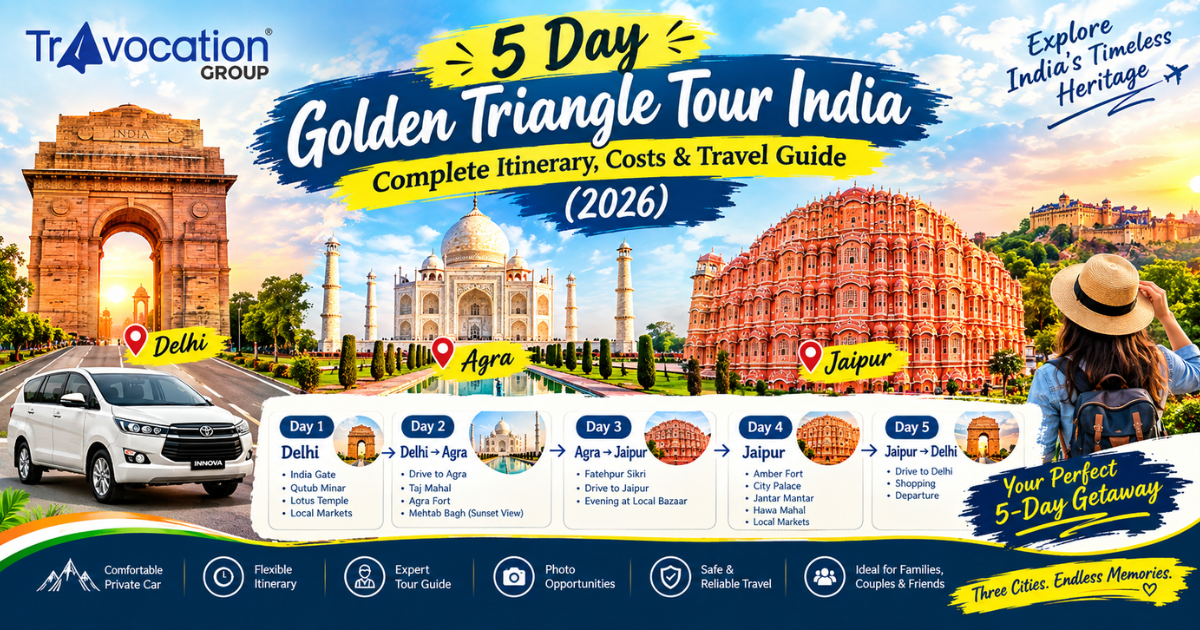
| 5 Days | Delhi (2N) → Agra (1N) → Jaipur (2N) | Most popular balanced itinerary |
| 7 Days | Delhi (2N) → Agra (1N) → Fatehpur Sikri → Jaipur (2N) + Ranthambore | Wildlife and heritage lovers |
| 10 Days | Golden Triangle + Goa or Mumbai extension | International travellers wanting variety |
A 3-Day Express Tour covering Delhi, Agra, and Jaipur is perfect for first-time visitors on tight schedules. A 5-Day Classic Tour is the most popular and well-balanced itinerary that Travocation recommends for most travellers. A 7-Day Heritage and Wildlife Tour extends the classic route with a stop at Fatehpur Sikri and a wildlife safari at Ranthambore National Park. A 10-Day Grand Circuit pairs the Golden Triangle with an extension to Goa or Mumbai, ideal for international visitors.
How to Travel Between the Cities on Golden Triangle Tours From Delhi
| Route | Car | Train | Flight |
| Delhi → Agra | 3–4 hours (Yamuna Expressway) | ~2 hours (Gatimaan/Shatabdi Express) | Not practical |
| Agra → Jaipur | 4–5 hours | 4–5 hours (limited trains) | Not practical |
| Jaipur → Delhi | ~5 hours | ~4.5 hours (Pink City/Shatabdi) | ~1 hour |
The most popular and comfortable option for the full circuit is a private air-conditioned car with a dedicated driver, booked through a reputed operator. This approach saves you the stress of coordinating transport, hotels, and local guides across three cities — and allows you to make spontaneous stops at roadside dhabas, mustard fields, and village temples along the way.
Accommodation Options for Every Budget
Travocation Tip: Wherever possible, opt for a heritage haveli stay in Jaipur. Waking up inside a centuries-old property with hand-painted frescoes on the walls is an experience that no modern hotel can replicate.
Must-Try Food Experiences on Golden Triangle Tours From Delhi
Food is an inseparable and deeply rewarding part of your Golden Triangle Tour From Delhi, and each city brings an entirely distinct culinary identity to the table.
In Delhi: Begin with Chole Bhature at Sita Ram Diwan Chand, eat Paranthe at the famous Paranthe Wali Gali in Chandni Chowk, enjoy Mughlai Kebabs at Karim’s near Jama Masjid, and try the original Butter Chicken at Moti Mahal in Daryaganj.
In Agra: Petha — a translucent sweet made from pumpkin — is the city’s most iconic edible souvenir and comes in dozens of flavours. Start mornings with Bedai, a spicy flatbread served with potato curry, and try the rich Mughlai Biryani for lunch.
In Jaipur: Dal Baati Churma is the soul of Rajasthani cuisine. Also try Laal Maas, a fiery red mutton curry cooked with Mathania chillies, and finish with Ghewar, a festive sweet soaked in sugar syrup. A traditional Rajasthani Thali covers every flavour profile in one magnificent spread.
Expert Tips for Planning Golden Triangle Tours From Delhi in 2026
Book monuments in advance — The Taj Mahal has timed-entry slots that fill up quickly during peak season. Use the official ASI website or book through your tour operator.
Start early every day — Monuments are most beautiful at sunrise, less crowded before 10 AM, and far more comfortable to explore before the midday heat sets in.
Dress appropriately — Carry a light scarf or dupatta as it is required when entering mosques and many temples along the route.
Carry cash — Local markets, auto-rickshaws, and small dhabas still operate primarily in cash even in 2026. Keep Indian rupees handy at all times.
Hire licensed guides only — Book guides through your hotel, through Travocation, or from the official ASI counter at each site. Avoid touts near entrance gates.
Remember the Friday closure — The Taj Mahal is closed every Friday. Plan your Agra visit accordingly to avoid the biggest scheduling mistake first-time travellers make on this circuit.
Carry a reusable water bottle — Especially between March and October, temperatures can be intense. Staying hydrated is essential for enjoying long days of sightseeing.
Conclusion
The Golden Triangle Tours From Delhi is not just a travel itinerary — it is a journey through the very heart and history of India. From the chaotic, beautiful charm of Delhi’s ancient lanes and the heartbreaking splendour of the Taj Mahal at sunrise, to the regal magnificence of Jaipur’s Amber Fort glowing golden in the afternoon light, every moment on this route feels like turning the pages of a living, breathing history book.
In 2026, with better connectivity, richer experiences, and more curated travel options than ever before, there has never been a better time to plan the Golden Triangle Tours From Delhi. Whether you choose a quick 3-day express trip or a leisurely 7-day immersion, this circuit promises to be one of the most rewarding and unforgettable journeys of your life.
At Travocation, we are passionate about crafting travel experiences that go far beyond the ordinary. Let us help you plan your perfect Golden Triangle tour from Delhi — tailored to your pace, your budget, and your sense of curiosity. Explore our curated 2026 packages and start planning your adventure today.
Frequently Asked Questions
Q1. How many days are enough for Golden Triangle Tours From Delhi?
Ans. A minimum of 5 days is ideal to comfortably cover Delhi, Agra, and Jaipur without feeling rushed.
Q2. What is the best time to visit the Golden Triangle?
Ans. October to March is the best time, with November and February being the most comfortable months for sightseeing.
Q3. Is the Taj Mahal open every day?
Ans. No — the Taj Mahal remains closed every Friday and is open from sunrise to sunset on all other days.
Q4. Can I do a Golden Triangle tour on a budget?
Ans. Yes — budget-friendly options include government trains like the Shatabdi Express, budget guesthouses, and self-guided itineraries.
Q5. Do I need a visa to visit the Golden Triangle as a foreign tourist?
Ans. Yes — international tourists require an Indian visa, which can be conveniently obtained as an e-Visa online before departure.