
 English
 Spanish
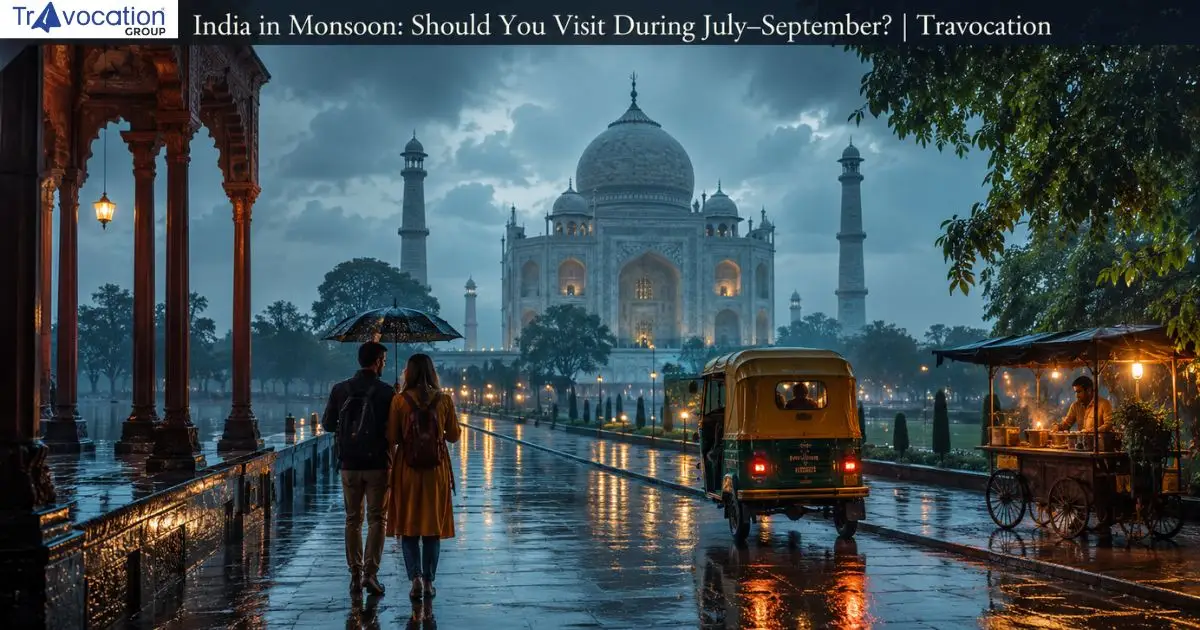
There is something undeniably magnetic about India in monsoon. The scorched plains turn emerald overnight, waterfalls roar back to life, and ancient temples shimmer in misty light. Moreover, the whole subcontinent seems to exhale after months of punishing heat. Yet most international travel guides warn you off the July–September window as if it were a travel sin.
So — should you actually visit India during the monsoon season? The honest answer is: it depends on where you go, what you want, and how prepared you are. At Travocation, we believe the monsoon is one of India’s most underrated travel seasons. Furthermore, this in-depth guide gives you everything you need to make a fully informed decision.
What Is the India in Monsoon Season? A Quick Overview
India’s monsoon arrives in two phases — the Southwest Monsoon and the Northeast Monsoon.
- The Southwest Monsoon hits Kerala around June 1st, sweeps north and east across the country, and dominates the July–September window.
- The Northeast Monsoon affects Tamil Nadu, Andhra Pradesh, and southeast India from October to December.
For the purpose of this guide, when we say “India in monsoon,” we refer to July, August, and September — the heart of the wet season across most of India.
| Month | Monsoon Intensity | Regions Most Affected | Tourist Crowd Level |
| June | Onset (moderate) | Kerala, Karnataka, Goa | Low |
| July | Peak (heavy) | Almost pan-India | Very Low |
| August | Peak (heavy) | North, Central, West India | Low |
| September | Retreating (moderate) | Most regions easing | Low–Medium |
According to data from the Indian Meteorological Department (IMD), the 2024 Southwest Monsoon delivered 934.8 mm of rainfall — roughly 107.6% of the normal figure — which made landscapes exceptionally lush and waterfalls particularly dramatic that year.
The Real Pros of Traveling India in Monsoon
Before you dismiss July–September entirely, here is why thousands of smart travellers deliberately choose this window every year.
1. Dramatically Lower Costs
First and foremost, the pricing is the biggest advantage. Budget hotels drop by around 30% during the monsoon off-season. In addition, upper-end and luxury properties slash rates by up to 50%. A 2024 travel industry survey confirmed that offbeat destinations during this season cost 30–50% less for stays and transport compared to peak-season equivalents.
For example, premium hotel nightly rates in Goa fall to roughly ₹14,000–₹27,000 per night at top properties — still luxurious, but far more accessible. As a result, you can enjoy five-star experiences at three-star prices. Airlines and leading travel platforms also roll out monsoon deals and discounted fares specifically to attract more travellers during the quieter season.
2. Fewer Crowds at Major Attractions
Imagine standing at the Taj Mahal in Agra — or walking through Hampi’s ancient ruins — with a fraction of the usual tourist density. That is the India in monsoon reality. Consequently, you get more space, better photographs, and far more authentic interactions with locals who are not overwhelmed by visitor numbers.
3. India’s Landscape at Its Most Beautiful
Above all, India in monsoon is visually spectacular. Every waterfall flows at full throttle, every hillside drapes itself in multiple shades of green, and the air carries the fresh scent of petrichor. Furthermore, Western Ghats destinations like Munnar, Coorg, and Lonavala reach their absolute peak of beauty during this window. If you love nature, therefore, this is the best time to visit.
4. Cooler and More Pleasant Temperatures
Temperatures across most of India during July–September range from 25°C to 35°C — significantly more comfortable than the brutal 40°C–48°C of April–June. As a result, the rains offer genuine relief and make daytime exploration far more enjoyable. Moreover, mornings and evenings during monsoon carry a cool breeze that simply does not exist during summer.
5. Vibrant Cultural Festivals
Additionally, some of India’s most joyful festivals fall during the monsoon months. Teej, Onam, Ganesh Chaturthi, Janmashtami, and Raksha Bandhan all occur between July and September. Therefore, travellers get a rare chance to witness authentic celebrations without the heavy commercialisation that often accompanies peak-season visits.
The Real Cons of India in Monsoon Travel
Honest travel writing demands equal space for the challenges. So here is what you genuinely need to prepare for before you book.
1. Landslides and Road Disruptions
In mountainous regions — particularly Himachal Pradesh, Uttarakhand, and parts of the Northeast — heavy rainfall regularly triggers landslides. These can block roads for hours or even days. For instance, cloud bursts have disrupted transport in Himachal Pradesh and Uttarakhand across multiple recent monsoon seasons. Therefore, always check road conditions before entering hilly regions and build buffer days into your itinerary.
2. Flooding in River Plains
North Indian cities near major rivers — including parts of Delhi, Bihar, and Assam — can experience serious flooding during peak monsoon weeks. However, this is not a reason to avoid India altogether. Rather, it is a reason to research your specific destination carefully before booking.
3. Humidity and Health Risks
The heat-humidity combination can be taxing, particularly in coastal and low-lying areas. Moreover, mosquito-borne illnesses — including dengue and malaria — see a noticeable uptick during the wet season. Therefore, carry mosquito repellent, use anti-malarial medication where appropriate, and choose accommodation with good hygiene standards.
4. Many Tiger Reserves and National Parks Close
Most of India’s celebrated wildlife sanctuaries — Ranthambore, Jim Corbett, Kanha, and Bandhavgarh — close between June 30 and October 1 so that forests can recover and animals can breed undisturbed. As a result, if a wildlife safari is the centrepiece of your trip, the India in monsoon window is not the right choice.
5. Certain Outdoor Activities Get Restricted
Beach water sports in Goa are suspended during the monsoon for safety reasons. Similarly, high-altitude treks in some Himalayan regions become risky. In addition, many coastal and beach shacks close entirely during this period. Consequently, flexibility and backup plans are not optional — they are absolutely essential.
Best Places to Visit in India in Monsoon (July–September)
Not all of India suffers equally in the rains. In fact, several destinations are either spectacular because of the monsoon or stay relatively dry during this season. Here is a curated list to guide your planning.
| Destination | Why It’s Great in Monsoon | Avg. Rainfall (July) | Best For |
| Munnar, Kerala | Tea gardens turn electric green; misty hills; Attukal Waterfalls | High | Nature lovers, couples |
| Coorg, Karnataka | Abbey Falls at full flow; coffee plantations at peak beauty | Very High | Trekkers, nature seekers |
| Shillong, Meghalaya | One of the world’s wettest places; Elephant Falls, misty landscapes | Extremely High | Rain lovers, photographers |
| Udaipur, Rajasthan | Lakes fill up; palaces reflect in the water; fewer tourists | Low–Moderate | Heritage, romance |
| Ladakh, J&K | Rain shadow zone — dry and dramatic during monsoon | Very Low | Adventure, landscapes |
| Lonavala, Maharashtra | Bhushi Dam overflows; lush valleys; Tiger’s Leap viewpoint | High | Weekend trips from Mumbai/Pune |
| Valley of Flowers, Uttarakhand | UNESCO site blooms only July–August | Moderate | Trekkers, botanists |
Hidden Gem: Meghalaya During India in Monsoon
If you truly love rain, Cherrapunji and Mawsynram in Meghalaya — both among the wettest places on Earth — offer an almost surreal monsoon experience. The waterfalls roar, the living root bridges glisten, and clouds roll through villages like slow-moving rivers. In short, this is India in monsoon at its most extraordinary and dramatic.
The Surprise Pick: Ladakh
Here is a destination most people do not associate with monsoon travel. Because Ladakh lies in the rain shadow of the Himalayas, it actually receives very little rainfall during July–September. While the rest of India is wet, Ladakh enjoys clear blue skies and dramatic high-altitude landscapes. As a result, July and August are arguably the single best months to visit Ladakh.
Places to Avoid in India During Monsoon
Being honest is central to everything we do at Travocation. Therefore, here are the destinations that present genuine challenges during July–September — along with better alternatives.
| Destination | Main Issue | Better Alternative |
| Mumbai | Heavy urban flooding; disrupted commutes | Visit October–February |
| Rajasthan cities (peak July) | Extreme humidity; safaris closed | Visit Sep–Oct after rains ease |
| Goa (beach-only trip) | Beach shacks closed; water sports banned; power cuts | Visit Oct–February or explore Goa’s green interior |
| Assam/Bihar (riverine areas) | Brahmaputra and Ganga flooding | Visit November–March |
| Andaman Islands | Rough seas; frequent ferry cancellations | Visit November–April |
India in Monsoon Packing Guide: What to Bring
Packing smart makes the difference between misery and magic. So before you travel India in monsoon, use this checklist to get fully prepared.
| Category | Essentials | Notes |
| Clothing | Quick-dry fabrics, light layers, waterproof jacket | Avoid heavy denim — it dries very slowly |
| Footwear | Waterproof sandals or shoes, flip-flops | Avoid canvas sneakers entirely |
| Gear | Dry bags, waterproof backpack cover, compact umbrella | Use plastic bags to protect electronics |
| Health | Mosquito repellent (DEET 30%+), anti-malarial tabs if needed, ORS sachets | Always consult a doctor before the trip |
| Documents | Store everything in a waterproof zip-lock bag | Also scan all documents digitally |
| Extras | Power bank, quick-dry towel, rain poncho | Power cuts occur regularly in some zones |
Is India in Monsoon Safe for Tourists?
Yes — and the answer is clearly yes, provided you exercise sensible precautions. India welcomes millions of domestic tourists during the monsoon every year. Furthermore, many international travellers from Europe and beyond make this journey successfully each season.
To stay safe, follow these key steps:
- Monitor IMD alerts — The India Meteorological Department issues real-time district-level warnings daily.
- Stay away from river banks and low-lying areas after heavy rainfall, especially in northern India.
- Book accommodation with a power backup — Power cuts occur more frequently in some monsoon-heavy zones.
- Buy comprehensive travel insurance — Because cancellations and delays are more likely during this period.
- Save emergency contacts — The national tourist helpline (1800-11-1363) and state tourism offices are highly useful.
Budget Travel During India’s Monsoon: What to Realistically Expect
One of the strongest reasons to visit India in monsoon is the outstanding value for money. So here is a realistic daily budget breakdown for a comfortable monsoon trip:
- Accommodation: ₹2,000–₹5,000 per night for a solid mid-range hotel (down from ₹4,000–₹9,000 in peak season)
- Food: ₹500–₹1,500 per day, depending on your dining preference
- Local transport: ₹300–₹800 per day
- Attractions and activities: ₹300–₹1,000 per day
- Overall comfortable daily budget: ₹4,000–₹7,000 per day for a solo traveller
Additionally, for offbeat destinations, you can find homestays for as little as ₹800–₹1,200 per night. As a result, monsoon travel is one of the most budget-friendly ways to explore India’s lesser-known and most scenic corners.
Month-by-Month Breakdown: July vs August vs September in India in Monsoon
Understanding the differences between these three months helps you choose the right window for your specific trip.
July delivers the most intense rainfall across most of India. In fact, this is peak monsoon at its rawest. However, it is the ideal time for Ladakh, Meghalaya, Munnar, and the Valley of Flowers. On the other hand, it is the least suitable for urban travel, peak Rajasthan humidity, and beach holidays.
August remains peak monsoon but begins to ease slightly in certain regions. Moreover, festivals like Janmashtami and Raksha Bandhan add tremendous cultural richness to any trip. As a result, destinations like Coorg, Lonavala, Shillong, and Udaipur shine especially brightly this month.
September marks the gradual retreat of the monsoon. Although landscapes stay lush and rivers remain full, the frequency of rain drops noticeably. Consequently, hotel prices stay low while weather improves — making September arguably the sweet spot of the entire India in monsoon travel window. In particular, from mid-September onward, even Rajasthan becomes pleasant and very accessible.
Travocation’s Verdict: Should You Visit India in Monsoon?
Yes — absolutely, if you choose the right destinations and prepare thoroughly.
The India in monsoon experience is genuinely unlike anything else. The landscapes are at their most dramatic. The country is quieter, more affordable, and in many ways more authentic than at any other time of year. Furthermore, the festivals are joyful and the light — that monsoon golden hour when the rain pauses and the sun breaks through — is nothing short of magical.
However, go in with realistic expectations. Some roads will wash out. Some plans will change. Power will flicker. But that is, in fact, part of the experience. Travellers who embrace it rather than fight it consistently report some of their most memorable and transformative journeys.
At Travocation, we have always believed that the best travel challenges and transforms you. And India in monsoon does exactly that — every single time.
Conclusion
Visiting India in monsoon is a bold, rewarding choice — not a mistake. With the right destination selection, smart packing, and flexible planning, July–September can be one of the most affordable, beautiful, and unforgettable times to experience this country. The landscapes are alive, the culture is vibrant, the crowds are thin, and the costs are significantly lower than peak season.
Whether you are drawn to the misty tea gardens of Munnar, the thundering waterfalls of Meghalaya, the dramatic skies over Ladakh, or the palace-reflected lakes of Udaipur — India in monsoon holds a version of itself for every type of traveller.
Plan smart. Pack right. And let the rains show you a side of India most tourists never see.
Frequently Asked Questions (FAQs)
Is it safe to travel to India in monsoon season?
Ans. Yes — monsoon travel in India is safe as long as you avoid flood-prone areas and monitor IMD weather alerts regularly.
Which is the best place to visit during India in monsoon?
Ans. Ladakh, Munnar, Coorg, Shillong, and Udaipur are the top destinations to experience India in monsoon at its best.
Is India cheaper to visit during the monsoon months?
Ans. Yes — hotels and flights are typically 20–50% cheaper during the monsoon off-season compared to peak winter travel.
Which places should I avoid in India during July–September?
Ans. Avoid Mumbai, coastal Andamans, flood-prone zones in Bihar and Assam, and beach-focused Goa if outdoor water activities are your priority.
Is September a good time to visit India during the monsoon?
Ans. Yes — September, especially from mid-month onward, is the sweet spot of the India in monsoon travel window with lush scenery and easing rainfall.