 English
 Spanish
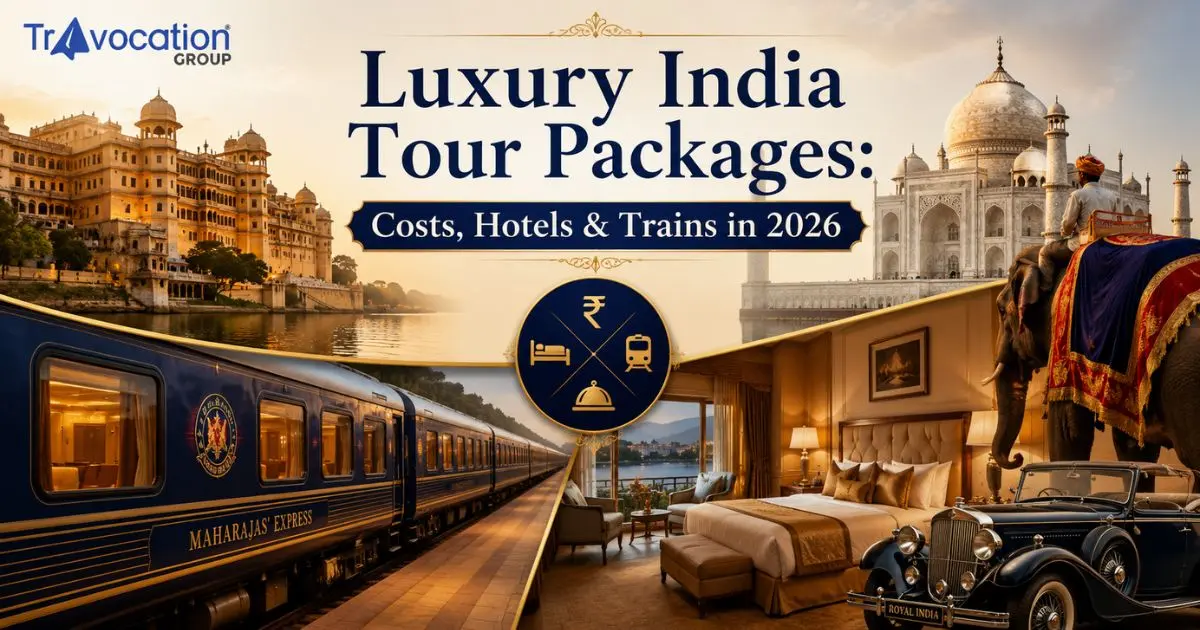
Planning luxury India tour packages means choosing between palace hotels, private guides, heritage trains, and fully customized itineraries instead of a fixed-departure group tour. For US travelers, a well-built luxury trip to India typically runs 10–14 days, costs $5,000–$15,000+ per person depending on the level of exclusivity, and blends iconic sights like the Taj Mahal with private experiences you can’t book on a standard package.
This guide by Travocation breaks down real 2026 pricing, visa requirements, the best luxury hotels and trains, and how to structure a trip so every day feels curated rather than crammed. Every figure below is sourced from a live, verifiable reference so you can plan your budget with confidence.
What Are Luxury India Tour Packages?
A luxury India tour package is a fully customized, high-end travel itinerary built around private transportation, five-star or palace-category hotels, and dedicated guides, rather than a shared coach and fixed group schedule. In practice, this means private airport transfers in a chauffeured vehicle, a personal guide at every monument, and accommodation in properties like The Oberoi or Taj Group hotels instead of mid-range chains.
Unlike a budget group tour, a luxury package is rebuilt around your pace. If you want three hours at the Taj Mahal at sunrise instead of a rushed 45-minute stop, that’s the point of paying for a private itinerary. Most luxury operators, including Travocation, also build in flexibility for weather, health, or simply wanting an extra night somewhere unexpected.
Luxury India tours generally fall into three tiers: premium (five-star hotels, private car and driver), ultra-luxury (palace hotels, luxury trains, private guides with specialist knowledge), and bespoke (helicopter transfers, access-only experiences, personal chefs). Understanding which tier fits your budget is the first real planning decision.
What’s Included in a Luxury India Tour Package?
A genuine luxury India tour package includes private transportation, five-star or heritage-palace accommodation, a dedicated English-speaking guide, all monument entry fees, and airport transfers built around your flight times rather than a group schedule. Meals are usually included at the hotel level (breakfast daily, sometimes half-board) with restaurant recommendations rather than forced group dining.
In practice, a strong itinerary also includes:
- A private, air-conditioned vehicle with a dedicated driver for the full trip
- One dedicated guide per city (not a single guide trying to cover the whole country)
- Skip-the-line or early-access monument entry, especially at the Taj Mahal
- 24/7 on-ground support from a local operator, not just a call center
- Flexibility to add optional experiences — cooking classes, textile workshops, wildlife safaris — without breaking the core itinerary
The package typically excludes international flights, alcohol beyond what the hotel includes, travel insurance, and personal shopping.
You May Visit Travocation’s Plan My Tour for Better Advice
How Much Do Luxury India Tour Packages Cost?
Luxury India tour packages for US travelers typically range from $350–$450 per person per day at the premium tier to $700–$1,200+ per person per day at the ultra-luxury tier, excluding international airfare. A 12-day Golden Triangle plus Rajasthan itinerary in premium hotels usually lands between $5,500 and $8,500 per person, while the same trip built around palace hotels and a luxury train segment can exceed $15,000 per person.
The main cost drivers are hotel category (five-star business hotel vs. heritage palace), private vehicle class, guide exclusivity, and whether the itinerary includes a luxury train segment. Seasonality matters too — peak winter months (November through February) run 15–25% higher than shoulder season.
| Tier | Per person, per day (USD) | Typical hotel category | Best for |
| Premium | $350–$450 | Taj, Oberoi, Leela business hotels | First-time luxury travelers wanting comfort and reliability |
| Ultra-luxury | $700–$1,200+ | Heritage palace hotels, Oberoi resorts | Milestone trips, honeymoons, multigenerational travel |
| Bespoke | $1,500+ | Palace suites, private wings, helicopter transfers | Once-in-a-lifetime, fully private itineraries |
Table 1: Approximate daily cost bands for luxury India tour packages by tier, exclusive of international flights.
What Is the Best Time of Year to Book Luxury Trips to India?
The best time for luxury trips to India is October through March, when daytime temperatures across North India sit between roughly 20–25°C in the cooler months, making sightseeing at the Taj Mahal, Jaipur’s forts, and Delhi’s monuments genuinely comfortable. India’s coldest months run from December to February, with southern and southeastern regions typically seeing 20–25°C and the colder northwest dropping to 10–15°C (source), which makes December and January ideal for Rajasthan’s palace circuit.
Summer, from March through June, is intense. Temperatures across the country average 30–35°C and can reach 40°C in parts of Central and Southern India (source), so this window is better suited to hill-station retreats in Shimla or the Himalayas rather than the classic Golden Triangle route. Monsoon season (roughly July–September) brings dramatic landscapes to Kerala and Goa but heavier rain to the north.
For a first-time luxury trip combining Delhi, Agra, and Jaipur, book between late October and early March. If Kerala’s backwaters or a wellness retreat is the focus, September through March works well, avoiding peak monsoon.
What Are the Best Luxury Train Journeys in India?
The best luxury train journeys in India are the Maharajas’ Express, Palace on Wheels, Deccan Odyssey, and The Golden Chariot, each running seasonal, multi-night itineraries through India’s heritage circuits with all meals, guided excursions, and butler service included. Shorter 3–4-night itineraries such as Treasures of India typically sit in the USD 4,900–8,600+ per person range in Deluxe or Junior Suite cabins, while 7-night itineraries range from about USD 7,800–15,600 per person in Deluxe or Junior Suites, rising to USD 25,000+ for top suite categories (source).
The Maharajas’ Express, operated in partnership with Indian Railways’ tourism arm, is the most internationally recognized option, with cabin fares starting around USD 4,900 per person (source). The train’s 14 carriages accommodate up to 88 guests total, keeping the experience genuinely exclusive rather than a full-capacity tourist train.
| Train | Typical duration | Starting price (per person, twin share) | Best for |
| Maharajas’ Express | 3–7 nights | ~$4,900 | First-time luxury rail travelers, Golden Triangle extension |
| Palace on Wheels | 7 nights | ~$4,000–$6,500 | Classic Rajasthan heritage circuit |
| Deccan Odyssey | 7–8 nights | ~$5,500–$8,000 | Maharashtra and Goa coastal-heritage combination |
| The Golden Chariot | 6–7 nights | ~$4,500–$7,000 | South India temples and wildlife |
Table 2: Indicative luxury train pricing bands for the 2026–27 season. Confirm exact tariffs directly with the operator, as fares are revised seasonally.
Most luxury trains operate only from September/October through April, pausing during the hottest months, so this needs to be locked into your itinerary early if a train segment is a priority.
Which Hotels Define Luxury Travel in India?
The properties that define luxury travel in India are heritage palace hotels and five-star resort brands — primarily The Oberoi, Taj Group’s IHCL palace properties, and The Leela — each offering a different flavor of Indian luxury, from converted royal residences to contemporary five-star service. The Oberoi Amarvilas in Agra sits just 600 metres from the Taj Mahal, and every one of its rooms and suites has unrestricted views of the monument (source) — a genuinely rare positioning advantage, since no other hotel in Agra can offer that.
Beyond Agra, expect palace conversions like the Oberoi Rajvilas in Jaipur (built around a heritage fort setting with reflection pools and gardens) and Taj Lake Palace in Udaipur, which sits on its own island in Lake Pichola. These aren’t marketing descriptions — they’re the literal architecture: former royal residences retrofitted with modern five-star infrastructure while keeping original design elements.
In practice, booking these properties 4–6 months ahead matters more than most first-time travelers expect. Palace hotels have limited room counts by design (often under 100 rooms), and the best view categories sell out for peak winter dates well before the season starts. This is one reason you should confirm luxury India tour packages built around named palace properties early rather than treat them as a placeholder in the itinerary.
Do I Need a Visa for Luxury Travel to India as a US Citizen?
Yes, US citizens need an e-Visa or regular visa to enter India for tourism, and the e-Tourist Visa is the standard choice for most luxury trips because travelers can apply for it entirely online. According to the Government of India’s official e-Visa fee schedule, US citizens pay government fees that vary by visa duration, with a 3% bank charge applied additionally on top of the listed fee (official fee PDF). The e-Tourist Visa comes in three durations — 30 days, one year, and five years — and applications can be submitted up to 120 days before a 30-day visa’s travel window (source).
A few practical details that matter for trip planning:
- Your passport must be valid for at least 6 months from your arrival date in India, with at least 2 blank pages for immigration stamping (source)
- Processing typically takes about 3 working days, though applying well in advance is recommended rather than applying at the last minute (source)
- e-Visa fees are generally lower during the “off-peak” season of April to June compared to the July–March “peak” season (source)
- Apply only through the official government portal, indianvisaonline.gov.in — third-party sites often charge inflated “service fees” on top of the government rate
Exact current US e-Visa fee at time of booking — confirm on the official portal, as India’s e-Visa fee schedule is revised periodically and fees are nationality-specific. A reputable operator building luxury India tour packages will typically flag visa timelines during the initial planning call, so the visa never becomes the bottleneck for a confirmed trip.
Is Luxury Travel to India Actually in Demand Right Now?
Yes — demand for luxury travel to and within India has grown sharply, driven by rising affluence among both international and domestic travelers. The India luxury travel market reached USD 75.7 billion in 2025 and is projected to grow at a compound annual rate of roughly 3.75% through 2034, driven by rising disposable incomes, a surge in high-net-worth individuals, and improved air connectivity (source).
This isn’t just an India-side trend. A 2024–25 research report from Marriott International’s Luxury Group found that 89% of Indian high-net-worth travelers said they planned to spend more on travel over the next 12 months (source) — one of the highest figures among the Asia-Pacific markets surveyed. On the inbound side, India’s Ministry of Tourism reported foreign tourist arrivals of roughly 9.95 million in 2024, with the United States remaining one of the top five source markets alongside the UK, Australia, and Canada (source).
As a result, the destinations and properties defining “luxury India” — palace hotels, heritage trains, private guiding — are seeing steadier booking pressure, which is another reason to lock in dates and rooms earlier rather than later for peak winter travel. Demand for luxury India tour packages specifically has followed this same upward curve, particularly among US and Australian travelers booking multi-city itineraries rather than single-destination trips.
How Do I Choose the Right Operator for My Luxury India Tour Package?
Choosing the right operator for a luxury India tour package comes down to three things: on-ground presence (not just a booking website), transparent per-day pricing broken down by hotel and vehicle category, and a real person you can reach if a flight changes or a monument closes unexpectedly. A quote that only lists a total price with no hotel names, guide structure, or vehicle category is a red flag — itemize luxury pricing instead.
Ask any operator directly:
- Which specific hotels the package includes, by name, not just “5-star category”
- Whether the operator dedicates the guide to your group or shares them with others
- What the cancellation and rescheduling policy looks like
- Whether the package includes airport meet-and-greet (not just transfer)
Comparing two or three quotes for luxury India tour packages side by side, line item by line item, is the single most useful thing you can do before booking.
Travocation builds every luxury India tour package around this level of transparency — naming exact properties, confirming private guide and vehicle arrangements upfront, and providing a dedicated trip coordinator from booking through your return flight.
You May Contact Travocation for Luxury India Tour Packages
Which Regions Should You Combine for a First Luxury Trip to India?
For a first luxury trip, the strongest combination is the Golden Triangle (Delhi–Agra–Jaipur) plus one additional region — either Rajasthan’s desert palaces, Kerala’s backwaters, or a luxury train segment — over 10–14 days. This gives enough time at each stop to avoid the rushed, checklist feeling of a shorter trip while still fitting comfortably around a two-week vacation window.
| Itinerary style | Duration | Regions covered | Approx. cost per person (premium tier) |
| Classic Golden Triangle | 7–8 days | Delhi, Agra, Jaipur | $3,000–$4,500 |
| Golden Triangle + Rajasthan | 11–13 days | Delhi, Agra, Jaipur, Udaipur, Jodhpur | $5,500–$8,000 |
| Golden Triangle + Kerala | 12–14 days | Delhi, Agra, Jaipur, Kochi, Alleppey backwaters | $6,000–$9,000 |
| Golden Triangle + Luxury Train | 10–12 days | Delhi, Agra, Jaipur + Maharajas’ Express segment | $9,500–$16,000+ |
Table 3: Common first-trip itinerary combinations and approximate premium-tier costs, excluding international flights.
Second and third trips to India tend to go deeper into a single region — a dedicated Kerala wellness itinerary, a Himalayan retreat, or a wildlife-focused safari circuit through Ranthambore and Bandhavgarh — rather than trying to cover the whole country again. Whichever combination you choose, the regions above form the backbone of most well-reviewed luxury India tour packages sold to US travelers today.
What Private Experiences Can You Add to a Luxury India Tour?
The most sought-after private add-ons for luxury India tours are after-hours monument access, private cooking classes with a local chef, textile and craft workshops, and wildlife safaris in Ranthambore or Bandhavgarh National Park. These experiences typically cost $150–$600 per person on top of the base itinerary but are what separates a memorable trip from a standard sightseeing schedule.
In practice, the highest-value additions tend to be experiential rather than transactional. A private sunrise session at the Taj Mahal before general admission opens, for instance, gives you the monument with a fraction of the crowd — a genuinely different experience from the mid-morning rush most day-trippers see. Similarly, a home-hosted dinner in Jaipur or Udaipur with a local family, arranged through a trusted ground operator, offers a level of cultural access that no hotel restaurant can replicate.
Common private add-ons include:
- Private early-morning or after-hours access to the Taj Mahal and other major monuments
- Hands-on cooking classes focused on regional cuisine (Rajasthani, Keralan, Mughlai)
- Block-printing, gemstone, or textile workshops with master artisans in Jaipur
- Half-day or full-day wildlife safaris in Ranthambore National Park, known for tiger sightings
- Hot-air balloon rides over Jaipur’s Amber Fort at sunrise
- Ayurvedic spa treatments and wellness consultations at resort properties in Kerala
For multigenerational trips or honeymoons, it’s worth budgeting an extra $500–$1,000 per person specifically for two or three of these experiences rather than trying to fit them all in — quality of experience matters more than checking off every option available. The best luxury India tour packages build in one or two of these add-ons by default rather than listing them as optional afterthoughts.
Ready to Book Your Luxury India Tour Package?
If you’re ready to move from research to an actual itinerary, Travocation can build a fully custom luxury India tour package around your travel dates, preferred hotel category, and must-see list — with named properties, a dedicated guide structure, and transparent per-day pricing from the first quote. Reach out for a no-obligation itinerary proposal built specifically around your dates and budget, not a repackaged group tour.
Conclusion
Luxury India tour packages reward travelers who plan ahead — for visas, for peak-season hotel availability, and for the trade-offs between premium, ultra-luxury, and bespoke tiers. The right combination of season, region, and hotel category turns a trip to India from a checklist into something genuinely memorable.
Frequently Asked Questions
Q.1 How much does a luxury India tour package cost for two people?
For a 12-day premium-tier trip covering the Golden Triangle and Rajasthan, budget roughly $11,000–$17,000 total for two travelers, excluding international flights.
Q.2 Is a luxury train like the Maharajas’ Express worth adding to an India itinerary?
Yes, for travelers who want an all-inclusive, slower-paced way to see multiple cities without repacking, though it adds $5,000–$15,000+ per person depending on cabin category and itinerary length.
Q.3 Do luxury India tour packages include international flights?
No, luxury India tour package pricing almost always excludes international airfare, so budget it separately.
Q.4 What is the best month to visit India for a luxury Golden Triangle tour?
December through February offers the most comfortable daytime temperatures for sightseeing in Delhi, Agra, and Jaipur.
Q. 5 Can US citizens get an India e-Visa for a luxury vacation?
Yes, US citizens can apply for an India e-Tourist Visa online through the official government portal, with processing typically taking about three working days.