
 English
 Spanish
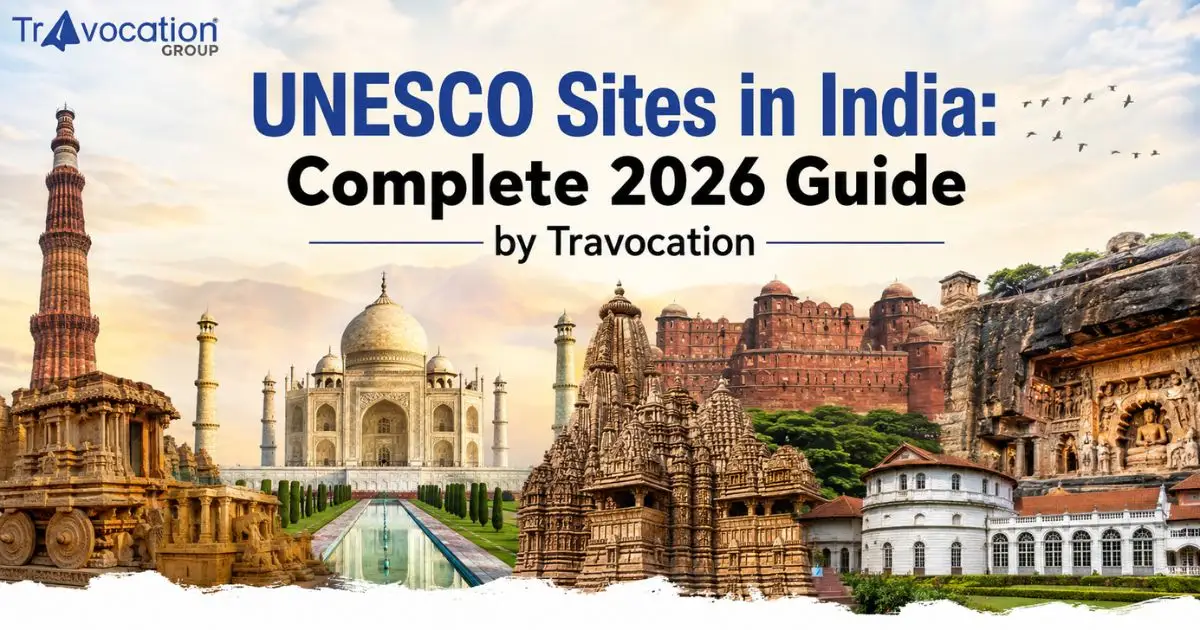
India holds 44 UNESCO World Heritage Sites as of 2026. This is the sixth-highest count in the world. These sites span 36 cultural landmarks, 7 natural reserves, and 1 mixed-category park. They are spread across 19 states and union territories. Whether you’re a first-time visitor or a seasoned traveller, this guide covers every major site, entry fees, best travel windows, and practical booking tips.
What Are UNESCO Sites in India — and Why Do They Matter?
UNESCO World Heritage Sites are locations of Outstanding Universal Value (OUV) recognised under the 1972 UNESCO World Heritage Convention. India ratified this convention on 14 November 1977. As a result, its sites became eligible for inscription. A property must meet at least one of ten specific criteria — covering cultural, historical, artistic, or natural significance — before it can be listed.
Why Does UNESCO Status Matter for Travellers?
The designation matters because UNESCO status guarantees a minimum standard of conservation and visitor infrastructure. When you visit a UNESCO world heritage site in India, you’re not just sightseeing. In fact, you’re standing inside a globally protected space where preservation is legally mandated.
Additionally, UNESCO recognition drives conservation funding and global awareness. India’s UNESCO journey began in 1983. That year, four sites — the Taj Mahal, Agra Fort, Ajanta Caves, and Ellora Caves — were inscribed simultaneously. The most recent addition is the Maratha Military Landscapes of India, inscribed in July 2025. [Source: UNESCO World Heritage Centre – India]
How Many UNESCO World Heritage Sites Are in India in 2026?
India has 44 UNESCO World Heritage Sites as of 2026, comprising 36 cultural, 7 natural, and 1 mixed site.
| Category | Count | Examples |
|---|---|---|
| Cultural | 36 | Taj Mahal, Ajanta Caves, Qutub Minar, Hampi |
| Natural | 7 | Sundarbans, Western Ghats, Kaziranga NP |
| Mixed | 1 | Khangchendzonga National Park (Sikkim) |
| Total | 44 | Spread across 19 states & UTs |
Table 1: UNESCO World Heritage Sites in India by category, as of 2026. Source: UNESCO WHC
India ranks sixth globally — behind Italy (61 sites) and China (60). Maharashtra leads all Indian states with the most inscriptions. These include the Ajanta Caves, Ellora Caves, Elephanta Caves, Victorian and Art Deco Ensembles of Mumbai, and 11 of the 12 forts in the newly added Maratha Military Landscapes.
What Are the Must-Visit UNESCO Sites in India?
The most visited heritage sites in India include the Taj Mahal (Agra), Ajanta and Ellora Caves (Maharashtra), Hampi (Karnataka), Qutub Minar (Delhi), and the Sun Temple at Konark (Odisha). These five sites represent the full breadth of India’s cultural legacy. They range from Mughal imperial architecture to ancient Buddhist monasteries and Hindu temple engineering.
Is the Taj Mahal the Most Famous UNESCO Heritage Site in India?
Yes. The Taj Mahal, inscribed in 1983, is India’s most visited UNESCO site and one of the New Seven Wonders of the World. Emperor Shah Jahan built it between 1632 and 1653. It was constructed as a mausoleum for his wife Mumtaz Mahal. The structure is located in Agra, Uttar Pradesh. Its white marble surfaces shift colour from pink at dawn to golden at sunset. However, no photograph fully captures this effect — you have to be there at 6 AM when the gardens are still quiet.
Entry fees (2026), as confirmed by the Archaeological Survey of India:
- Indian nationals: ₹50 (complex) + ₹200 (main mausoleum) = ₹250 total
- Foreign tourists: ₹1,100 (complex) + ₹200 (mausoleum) = ₹1,300 total
- SAARC/BIMSTEC nationals: ₹540 total
- Children under 15: Free for all nationalities
The Taj Mahal is closed every Friday for mosque prayers. It is open Saturday–Thursday from 30 minutes before sunrise to 30 minutes before sunset. Book tickets online at asi.payumoney.com to skip the gate queue. Online bookings include a ₹50 discount per foreign ticket and ₹5 per Indian ticket.
Best time to visit: October to March. Arrive at gate-opening to see the monument in soft morning light before the crowd builds.
What Are the Best UNESCO Sites in South India?
South India’s standout UNESCO heritage sites include the Brihadeeswarar Temple (Tamil Nadu), the Hoysala Sacred Ensembles (Karnataka), and the Group of Monuments at Mahabalipuram (Tamil Nadu). The Great Living Chola Temples were inscribed in 1987 and extended in 2004. They demonstrate the Chola Empire’s engineering ambition on a scale rarely seen in medieval architecture.
Furthermore, the Hoysala Sacred Ensembles at Belur, Halebid, and Somanathpura (inscribed 2023) are outstanding for detail-obsessed travellers. Every inch of their exterior walls is carved with figures and narratives. In contrast to European cathedrals of similar quality, these temples draw only a fraction of the visitor numbers.
Complete List of UNESCO World Heritage Sites in India (2026)
Table 2: All 44 UNESCO World Heritage Sites in India — year of inscription, location, and category
| # | Site | State/UT | Year Inscribed | Category |
|---|---|---|---|---|
| 1 | Ajanta Caves | Maharashtra | 1983 | Cultural |
| 2 | Ellora Caves | Maharashtra | 1983 | Cultural |
| 3 | Agra Fort | Uttar Pradesh | 1983 | Cultural |
| 4 | Taj Mahal | Uttar Pradesh | 1983 | Cultural |
| 5 | Sun Temple, Konark | Odisha | 1984 | Cultural |
| 6 | Group of Monuments, Mahabalipuram | Tamil Nadu | 1984 | Cultural |
| 7 | Kaziranga National Park | Assam | 1985 | Natural |
| 8 | Manas Wildlife Sanctuary | Assam | 1985 | Natural |
| 9 | Keoladeo National Park | Rajasthan | 1985 | Natural |
| 10 | Churches and Convents of Goa | Goa | 1986 | Cultural |
| 11 | Fatehpur Sikri | Uttar Pradesh | 1986 | Cultural |
| 12 | Group of Monuments, Hampi | Karnataka | 1986 | Cultural |
| 13 | Group of Monuments, Khajuraho | Madhya Pradesh | 1986 | Cultural |
| 14 | Elephanta Caves | Maharashtra | 1987 | Cultural |
| 15 | Great Living Chola Temples | Tamil Nadu | 1987/2004 | Cultural |
| 16 | Group of Monuments, Pattadakal | Karnataka | 1987 | Cultural |
| 17 | Sundarbans National Park | West Bengal | 1987 | Natural |
| 18 | Nanda Devi & Valley of Flowers NPs | Uttarakhand | 1988/2005 | Natural |
| 19 | Buddhist Monuments at Sanchi | Madhya Pradesh | 1989 | Cultural |
| 20 | Humayun’s Tomb | Delhi | 1993 | Cultural |
| 21 | Qutub Minar and its Monuments | Delhi | 1993 | Cultural |
| 22 | Mountain Railways of India | Multiple | 1999/2005/2008 | Cultural |
| 23 | Mahabodhi Temple, Bodh Gaya | Bihar | 2002 | Cultural |
| 24 | Rock Shelters of Bhimbetka | Madhya Pradesh | 2003 | Cultural |
| 25 | Chhatrapati Shivaji Maharaj Terminus | Maharashtra | 2004 | Cultural |
| 26 | Champaner-Pavagadh Arch. Park | Gujarat | 2004 | Cultural |
| 27 | Red Fort Complex | Delhi | 2007 | Cultural |
| 28 | Jantar Mantar, Jaipur | Rajasthan | 2010 | Cultural |
| 29 | Western Ghats | Multiple | 2012 | Natural |
| 30 | Hill Forts of Rajasthan | Rajasthan | 2013 | Cultural |
| 31 | Rani ki Vav, Patan | Gujarat | 2014 | Cultural |
| 32 | Great Himalayan National Park | Himachal Pradesh | 2014 | Natural |
| 33 | Archaeological Site of Nalanda | Bihar | 2016 | Cultural |
| 34 | Khangchendzonga National Park | Sikkim | 2016 | Mixed |
| 35 | Arch. Work of Le Corbusier (Chandigarh) | Chandigarh | 2016 | Cultural |
| 36 | Historic City of Ahmadabad | Gujarat | 2017 | Cultural |
| 37 | Victorian Gothic & Art Deco, Mumbai | Maharashtra | 2018 | Cultural |
| 38 | Jaipur City | Rajasthan | 2019 | Cultural |
| 39 | Dholavira: A Harappan City | Gujarat | 2021 | Cultural |
| 40 | Hoysala Sacred Ensembles | Karnataka | 2023 | Cultural |
| 41 | Santiniketan | West Bengal | 2023 | Cultural |
| 42 | Sacred Ensembles of the Hoysalas | Karnataka | 2023 | Cultural |
| 43 | Moidams – Mound-Burial System, Ahom Dynasty | Assam | 2024 | Cultural |
| 44 | Maratha Military Landscapes of India | Maharashtra/Tamil Nadu | 2025 | Cultural |
Source: UNESCO World Heritage Centre – India
What Are the Newest UNESCO Heritage Sites in India?
India’s two most recent UNESCO additions are the Moidams of Assam (2024) and the Maratha Military Landscapes of India (2025). These additions signal India’s expanding approach to heritage recognition. Specifically, they move beyond iconic monuments toward underrepresented dynasties and regions.
What Are the Maratha Military Landscapes of India?
The Maratha Military Landscapes of India, inscribed in July 2025, comprise 12 historic forts linked to the Maratha Empire. Of these, 11 are in Maharashtra and 1 (Gingee Fort) is in Tamil Nadu. Key forts include Raigad, Shivneri, Lohagad, Pratapgad, and Panhala. These structures showcase the Maratha rulers’ strategic genius and military architecture from the 17th to 19th centuries. Moreover, this inscription marks the first time the Maratha Empire’s physical legacy has received UNESCO recognition.
What Are the Moidams of Assam?
Moidams are the mound-burial structures of the Ahom Dynasty, which ruled Assam for nearly 600 years (1228–1826 CE). Inscribed in 2024, the Moidam site at Charaideo is often called the “Pyramids of the East.” These are conical earthen mounds that house royal burials with elaborate grave goods. As a result, this site offers one of India’s most uncrowded and unusual heritage experiences in the northeast.
You May Also Like This – Best Time to Visit India
Which UNESCO Sites Are Best for Nature Lovers?
India’s 7 UNESCO natural heritage sites include Kaziranga National Park (Assam), Sundarbans National Park (West Bengal/Bangladesh), the Western Ghats, Manas Wildlife Sanctuary, Keoladeo National Park, Nanda Devi & Valley of Flowers (Uttarakhand), and Great Himalayan National Park (Himachal Pradesh).
| Natural Site | Key Wildlife | Best Visit Season |
|---|---|---|
| Kaziranga NP, Assam | Indian one-horned rhino, tigers | Nov – Apr |
| Sundarbans NP, West Bengal | Bengal tigers, Irrawaddy dolphins | Oct – Mar |
| Western Ghats | Leopards, endemic amphibians | Oct – Feb |
| Valley of Flowers, Uttarakhand | Endemic alpine flora, snow leopard | Jul – Sep |
| Khangchendzonga NP, Sikkim (Mixed) | Red pandas, Himalayan black bear | Apr – Jun |
Table 3: UNESCO natural heritage sites in India — key wildlife and ideal visit season
Why Is Kaziranga a Must-Visit Natural UNESCO Site?
Kaziranga is home to more than two-thirds of the world’s Indian one-horned rhinoceros population. It remains one of the most successful wildlife conservation stories in Asia. Jeep safaris inside the park start from around ₹1,500–₹2,500 per person depending on zone and vehicle type [VERIFY exact current rates with park authorities before visit].
What Makes Sundarbans Unique Among UNESCO Sites in India?
The Sundarbans straddle the India-Bangladesh border. They contain the world’s largest contiguous mangrove forest. Additionally, Bengal tigers here have adapted to swimming between islands — a behaviour unique to this ecosystem.
Visit For This – Travocation’s Wildlife Packages
When Is the Best Time to Visit UNESCO Sites in India?
The best time to visit most UNESCO world heritage sites in India is October to March. During these months, temperatures are moderate and skies are clear. However, the right window varies by site type and region.
| Site Type | Ideal Season | Reason |
|---|---|---|
| North Indian monuments (Taj Mahal, Agra Fort, Red Fort) | Oct – Mar | Cool temperatures, optimal photography light |
| South Indian temples (Hampi, Mahabalipuram, Hoysala) | Oct – Feb | Post-monsoon freshness, manageable heat |
| Himalayan sites (Valley of Flowers, Khangchendzonga) | Jun – Sep | Access roads open, peak blooming season |
| Wildlife sanctuaries (Kaziranga, Sundarbans) | Nov – Apr | Dry season, animals concentrate near water |
| Ajanta & Ellora Caves | Oct – Mar | Comfortable cave exploration, crowd manageable |
Table 4: Best season to visit UNESCO heritage sites in India by site type
Can You Visit UNESCO Sites in India in Summer?
April to early June can work for South Indian and cave sites. However, you must visit before 10 AM to avoid the heat. The post-Holi lull in March–April also means smaller crowds at popular sites. For example, the Taj Mahal and Hampi see noticeably fewer visitors during this window. At Ajanta, the rock-cut Buddhist paintings are best viewed in natural light. Specifically, mornings from October to February deliver ideal lighting conditions without midday glare.
How to Plan a UNESCO Heritage Trip Across India with Travocation
A well-planned India UNESCO heritage tour typically covers 3–4 major sites in 10–14 days. The key is to organise sites by geographic cluster rather than scatter them across the country.
Which Is the Best Heritage Circuit for First-Time Visitors?
The Golden Triangle + Rajasthan Cluster is India’s most established heritage circuit. It covers the Taj Mahal (Agra) → Agra Fort → Fatehpur Sikri → Jantar Mantar (Jaipur) → Hill Forts of Rajasthan → Jaipur City. This circuit is easily done in 6–8 days.
What Is the Best UNESCO Route in Maharashtra?
The Maharashtra Cave Circuit covers Mumbai to Aurangabad and back. Specifically, it runs: Mumbai (Victorian/Art Deco, Elephanta Caves) → Ajanta Caves → Ellora Caves → Chhatrapati Shivaji Maharaj Terminus. Best covered in 5–6 days with an overnight stop in Aurangabad.
How Long Does the South India Temple Trail Take?
The South India Temple Trail connects Tamil Nadu, Karnataka, and Telangana’s finest heritage sites. The route runs: Mahabalipuram → Great Living Chola Temples (Thanjavur) → Hoysala Sacred Ensembles (Belur/Halebid) → Group of Monuments at Pattadakal → Hampi. Plan for 8–10 days at a comfortable pace.
Travocation builds customised itineraries for every budget — from budget heritage trail packages to private-guided luxury circuits with skip-the-queue access, accommodation near heritage zones, and local expert guides at each site.
Ready to explore India’s UNESCO sites? Plan Your Heritage Tour with Travocation → Our heritage travel specialists create day-by-day itineraries tailored to your schedule, budget, and interests — covering flights, accommodation near UNESCO zones, and expert local guides at every site. No cookie-cutter packages.
Frequently Asked Questions About UNESCO Sites in India
Q.1 How many UNESCO World Heritage Sites are in India in 2026?
India has 44 UNESCO World Heritage Sites as of 2026, comprising 36 cultural, 7 natural, and 1 mixed-category site (Khangchendzonga National Park, Sikkim), making it the sixth-highest-ranked country globally.
Q.2 Which is the newest UNESCO World Heritage Site in India?
UNESCO inscribed the Maratha Military Landscapes of India in July 2025, making it India’s most recent World Heritage Site — a collection of 12 historic forts linked to the Maratha Empire, spread across Maharashtra and Tamil Nadu.
Q.3 What is the only mixed UNESCO World Heritage Site in India?
Khangchendzonga National Park in Sikkim is India’s sole mixed UNESCO World Heritage Site, recognised in 2016 for both its outstanding natural biodiversity across extreme Himalayan elevations and its cultural significance as a sacred indigenous landscape.
Q.4 How much does it cost to visit the Taj Mahal in 2026?
The Taj Mahal entry fee in 2026 is ₹50 for Indian nationals (plus ₹200 for the main mausoleum interior) and ₹1,100 for foreign tourists (plus ₹200 for the mausoleum), with children under 15 entering free. Tickets can be booked online at asi.payumoney.com.
Q.5 Which state in India has the most UNESCO World Heritage Sites?
Maharashtra has the most UNESCO World Heritage Sites of any Indian state, including the Ajanta Caves, Ellora Caves, Elephanta Caves, Victorian and Art Deco Ensembles of Mumbai, and 11 of the 12 forts in the Maratha Military Landscapes inscribed in 2025.
Conclusion
India’s 44 UNESCO sites represent more than monuments — they are living evidence of five millennia of civilisation, ecological evolution, and cultural coexistence. From the marble perfection of the Taj Mahal to the mound-burial legacy of the Ahom kings in Assam, each site rewards the prepared traveller. The best way to experience these heritage sites in India is with a well-planned itinerary that groups sites by region, respects seasonal access windows, and prioritises early-morning visits for both photography and crowd management. Travocation exists to make that planning effortless.
You May Also Like This – Travocation’s Private Tour Packages
Written by Travocation — India’s dedicated heritage travel planning platform. All entry fee data sourced from the Archaeological Survey of India (asi.payumoney.com) and the official Taj Mahal website (tajmahal.gov.in). UNESCO site counts verified via the UNESCO World Heritage Centre (whc.unesco.org/en/statesparties/in), current as of June 2026.